

Warning: This story contains a discussion about suicide
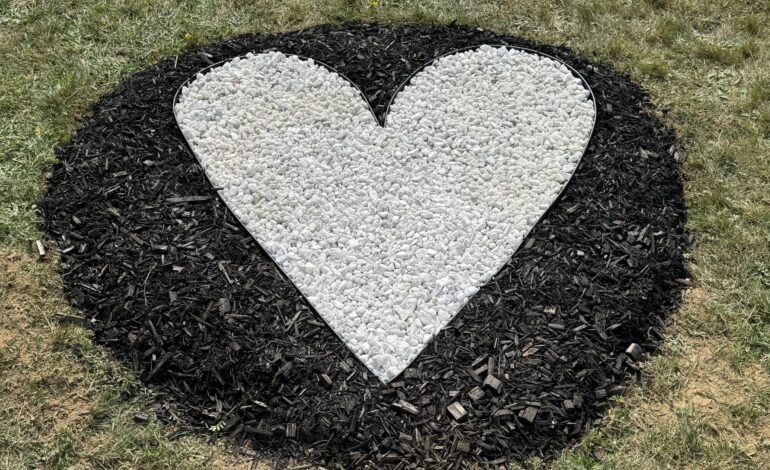
A white heart framed in black and filled with pale stones rests in the ground at Langmaid Park, just off Water Street in St. Andrews. A few blocks away, another punctuates the landscaping at Salty Towers Inn, a gathering place beloved by locals and visitors alike. Farther along the waterfront, a third sits in the place of a flowerbed outside Buoy Up!, a shop whose name means, simply, to lift someone’s spirits.
You may notice the hearts without knowing why they are there. Even so, they have an effect: they slow a walk, lighten a moment, invite reflection.
The hearts are part of Operation White Heart, a grassroots mental-health initiative that began in Saint John in 2022. Its founder, Gary Brown, did not set out to start a movement, or even a program. He was responding to what he was hearing.
Brown’s involvement in suicide prevention traces back to the Maddy Murphy Memorial Fund, created after the death of a young woman whose loss rippled through her community. While helping sell memorial stickers in support of the fund, Brown began hearing stories from people who had lost loved ones, and from others who quietly admitted they themselves had struggled.
“It woke me up,” Brown said. “I realized this was much bigger than I ever knew.”
Searching for a way to acknowledge that shared weight, Brown approached a church in Saint John and asked permission to create a small public space. At its centre stood a 17-foot white heart, flanked by benches dedicated to young people lost too soon. When the park opened in 2021, people were drawn to it. They stopped. They sat. More often than not, they talked.
What surprised Brown was not the attention, but the response.
“People kept telling me the heart was beautiful,” he said. “And I thought to myself, well, let’s take that big heart and scale it down and put small ones on people’s lawns.”
That thought stayed with him. Over the winter, Brown began to wonder what might happen if the symbol moved beyond the park and into everyday life. He encouraged people to build smaller white hearts on their own properties. When he shared the idea online, the response was immediate. Dozens of people reached out, asking for hearts of their own.
By the spring of 2022, Operation White Heart had taken shape, not as a formal organization, but as a growing network of symbols and conversations.
As requests increased, Brown began building and installing hearts for those who asked. Modest commissions followed, and with them came a question he had not anticipated: what should the money support?
The answer came from his own experience.
In 2020, Brown had taken Applied Suicide Intervention Skills Training, known as ASIST. The program does not promise solutions or quick fixes. Instead, it teaches ordinary people how to listen, how to ask direct questions, how to sit with discomfort, and how to help someone feel less alone long enough to reach a safer place.
“[ASIST] not only teaches you how to save people and bring them back to a safe place, but it teaches you how to listen,” Brown said. “To me that was the most important part because I didn’t know how to listen.”
He began to see that the hearts were already doing something similar. They created moments of presence and opened space for conversation. Funding ASIST felt like a natural extension of that instinct. Through commissions from white heart installations, Brown has since helped fund ASIST training for more than 140 people across New Brunswick and beyond.
In St. Andrews, the town’s Mental Wellness Committee, a council-appointed group formed in 2025, learned about Operation White Heart and commissioned the installation of the first local heart at Langmaid Park.
“When we were thinking about how we can build support and build awareness for mental wellness and mental health in our area, we wanted to be able to do some tangible things, and to also have some opportunities for people to get involved,” said Caleigh Dunfield, who is a committee member.
Inspired by how Brown paired visibility with skill-building, the committee decided to take the next step. With funding from the Fundy Community Foundation, it brought ASIST training to St. Andrews in a way that would reach as many people as possible.
Over the course of two days in mid-January 2026, over 20 residents completed the training, including people from schools, the nursing home, the fire station and search and rescue.
“It’s huge to know that at the end of the two-day training, we have over 20 newly qualified folks just in our small area who have that skill set and that motivation,” said Dunfield said.
Participants learned how to listen without rushing, how to ask again when someone says they are fine, and how to stay with someone in a difficult moment rather than trying to fix it.
When Brown visited St. Andrews to see the hearts in place and the training underway, he saw something he had not planned, but had hoped for.
“That’s how it’s supposed to work,” he said. “I can’t be everywhere. Communities take it on themselves.”
New hearts continue to appear, many built by people Brown has never met in towns he has never visited.
In St. Andrews, the hearts remain along Water Street, quiet and unassuming, easy to miss. They are not monuments to despair, but small, steady signs of care and compassion in a winter-lit town. Behind them is something sturdier still: a growing network of people learning how to listen, how to notice, how to be there.
If you or someone you know is in immediate danger, call 911. Help is available 24/7.
Here are some resources:
-
9-8-8: Suicide Crisis Helpline: Call or text 9-8-8. Support is available 24/7.
-
Kids Help Phone: 1-800-668-6868 or text CONNECT to 686868
-
Hope for Wellness Helpline for Indigenous peoples: 1-855-242-3310
-
Trans Lifeline: 1-877-330-6366