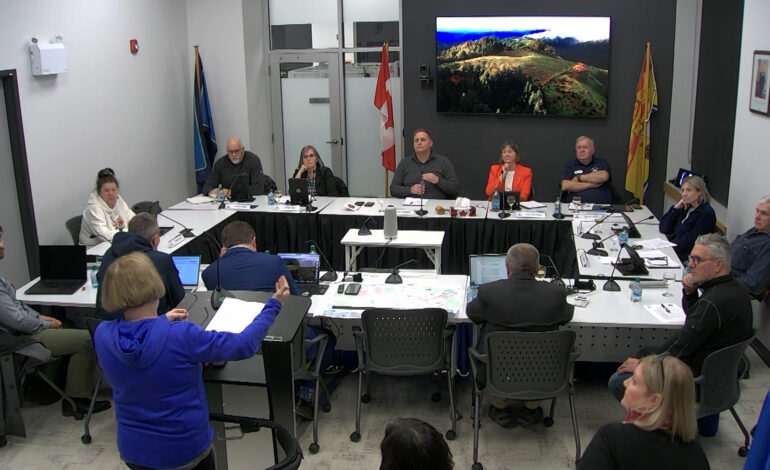


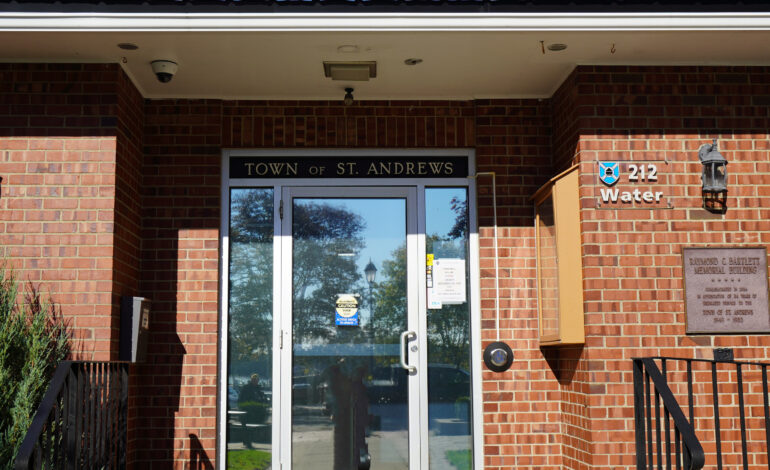
The Town of St. Andrews is moving to amend its procedural bylaw to make staff-led meetings open to the public and to keep minutes of the local governments discussions.
Staff-led meetings were only recently placed on the town’s meeting calendar, as of August 2025. These meetings are led by Chief Administrative Office Chris Spear who discusses various policies, issues in preparation for decision making.
However, Bylaw 23-06 currently states under section 8.2 states “staff meetings of council are staff-led and will not be televised or broadcast to the public and are not open to the public to attend in person.”
The Local Governance Act outlines the reasons a council ‘may’ enter closed session under Section 68(1).
Coun. Lee Heenan read out to the council the background on the changes to the bylaw.
“In August 2025, council started to review the staff-led meeting following concerns raised by a resident regarding the closed nature of the meetings,” he said during the meeting on Jan. 19. “Staff had researched requirements in the Local Governance Act and the models of municipalities regarding a similar meeting style.
“It is not the most honest form of government.” — Geoff Martin, Mount Allison University professor.
“An amendment has been prepared by staff to provide more detail for the meeting’s purpose, format, and procedure.”
It provides clarity on the purpose of the meeting, including the informal style, that it is chaired by someone other than the mayor, and that those meetings be open to the public.
The amendment is not yet in place because the change requires three readings by the local government before it is enacted.
Spear confirmed to The Courier the bylaw was amended to open those meetings to the public.
“Council also suspended the rule for staff-led meetings to be closed part way through 2025 to allow the public access,” he said in the email statement. “It needs to be noted that no decisions were made.”
Spear added the meetings allowed staff to update the council on ongoing initiatives and get direction on future meetings.
“Sometimes guests would be invited to provide an update/input on an initiative,” he said.
Between 2024 and 2025, 17 staff-led meetings were held in closed session, according to Spear.
‘Don’t tell me, show me’
Geoff Martin, an assistant professor who studies New Brunswick politics at Mount Allison University in Sackville, said any discussion that involves policy or use of tax dollars, like building a facility or improving sidewalks, should be done in public.
He said a voter should know where each individual councillor stands on an issue, even if they don’t agree, to inform how they choose to be represented.
“You don’t know that if you’re only relying on the superficiality of a council meeting where not much is said, because everyone’s voting for motions and budgets and things that everything’s been worked out in advance,” he said, speaking to The Courier.
Martin said he believes councils do this to protect themselves.
“Let’s stay unanimous as a group, and we’re all protected, because no one can figure out if there’s something they don’t like,” he said. “Well, we can say, that’s someone else’s fault, but we can’t really say who and we’ll all take credit for what the voters do like, even if some of us never supported it.
“It is not the most honest form of government.”
Martin said there is accountability attached to saying things in public.
“I think if you try to avoid accountability by saying as little in public as possible, that itself, I think, erodes trust because … when it comes to government, including municipal government, they (the public) have a show me attitude. Don’t tell me, show me,” he said.
It comes a month after the Local Governance Commission released an advisory to all municipalities in the province saying code of conduct and conflict of interest could not be discussed in closed session, outside of the advice of a solicitor or lawyer, which is contained under Section 68(1) of the Act.
The Commission also asked the councils to review the code of conduct bylaw to bring it in line with the Act.
What happens elsewhere
In St. Stephen, a similar meeting known as Committee of the Whole—where staff give reports, discuss various initiatives, receive presentations, and review policy and is similar to the St. Andrews staff-led meeting—but is and has been open to the public, recorded, and broadcast.
St. Stephen council has held code of conduct and conflict of interest complaints in closed session, which is not permitted under the Act. The council brought the code of conduct bylaw before council on Jan. 14 through Committee of the Whole to bring it into compliance with the commission’s advisory.
“The Commission in its wisdom has made a clarification statement banning the decision making or much of the dialogue around any code of conduct complaint from being held in closed, which is common practice across Canada to be perfectly honest with you,” said St. Stephen Chief Administrative Officer Jeff Renaud.
“As a result of their decision, we had to go through our bylaw and remove any references to closed session with the exception of solicitor advice [or] the results of an investigators report, which is generally done by a solicitor.”
Coun. Wade Greenlaw asked how the commission would suggest councillors become familiar with the various Acts it is required to follow.
The Commission recommended mandatory training within six months of an election of elected officials and staff on the legislations and the responsibilities of holding municipal office.
Renaud said this would also be part of an orientation package being prepared ahead of the incoming council—a project he took on with the late Coun. Earl Eastman.
“I understand the pressures but then we’re a democracy and it becomes very difficult to try and limit the public’s input.”
“We are spending time [within our] internal orientation program on some of those key items,” he said, adding there is an individual responsibility that each councillors holds to keep themselves informed of the proper rules and regulations assigned to local governments.
No decisions were made during the Committee of the Whole, but is expected to be brought before council for three readings over the next several weeks.
The Courier reviewed the procedural bylaw for Eastern Charlotte and found no reference to closed meetings outside of those allowed by the Act.
Eastern Charlotte Chief Administrative Officer Jason Gaudet said it does hold Committee of the Whole Meetings, similar to St. Stephen, but published minutes do reflect some of those meetings, in part, were held in closed session but cites the reason.
Jamie Gillies, a professor of public policy at St. Thomas University, said councils across the province have fallen apart because of internal dynamics.
“Sometimes it is just a bit of a learning curve,” he said, adding he believes there is likely some pressure when there are meetings with stakeholders or experts to hold those in closed.
“I think part of it is the stress and concerns of elected council members and the basic decorum of the public,” he said. “This has become an era where people will come before council with anything that bothers them, and it takes a lot of time to address those issues and council has to get through a lot of things in these meetings.
“I understand the pressures but then we’re a democracy and it becomes very difficult to try and limit the public’s input.”