

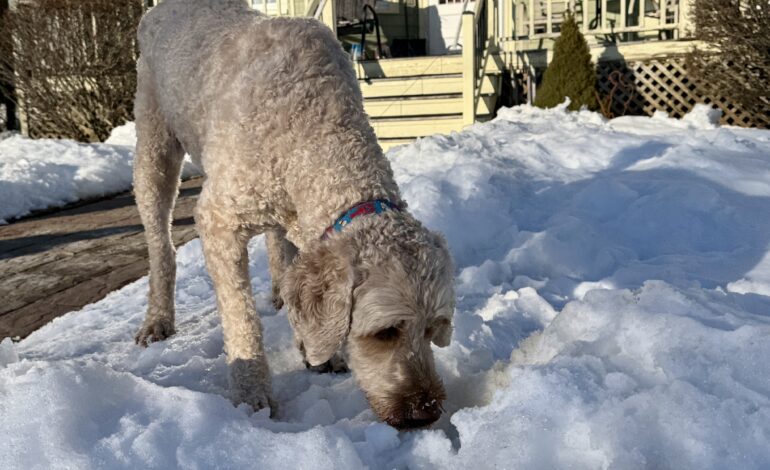
Maud sniffs longer in the winter.
Not casually or politely. She lowers her nose to the snow with the intensity of a detective who has just stumbled onto the one detail that explains everything. Her body tightens. Her focus narrows. The rest of the world disappears as she inhales with purpose, tugging me toward snowbanks like we’re Sherlock Holmes & Dr. John Watson and she’s just spotted the break in the case. Whatever is happening down there is important, urgent, and not to be rushed, regardless of how wet my boots are becoming.
Watching a dog encounter a familiar scent is strangely absorbing. There’s a shift in posture, a visible click of recognition, the determination to gather more evidence. I assume it’s one of her enemies—squirrels, most likely—or perhaps a member of her local canine network. Maud has many acquaintances, a few friends, and several sworn adversaries, though the criteria for these distinctions remain a mystery. Dogs, however, are consistent. They remember. They keep tabs.
This is what dogs do on walks. While we admire trees, peer into windows, and note which neighbours still have their Christmas lights up, dogs are conducting a far more serious investigation. They smell.
Most of the year, we can only guess at what they’re discovering. Winter, however, gives everything away. Snow is an honest medium. Footprints announce who’s been where. Paw prints overlap like timestamps. And then there are the yellow annotations—some fresh, some ancient, all meaningful. Fresh is thrilling. Fresh demands a response. A reply, as we like to say. A pee-mail back.
Going outside to smell where everyone has been is Maud’s version of social media. Our stroll is her scroll, and she approaches it with both passion and focus. There is one front lawn we must always stop at: Diesel’s. Diesel’s yard on Water Street is the canine message board of the town. Maud is shy around Diesel in person, but this does not prevent her from leaving him a note. Even if she has already relieved her bladder, she will circle the yard until she finds just enough left to say, “Maud was here.” It’s not about necessity. It’s about participation.
Dogs smell thousands of times better than we do. It’s their way of moving through the world. They can recognize individuals, detect illness and stress, and determine how long ago someone passed through. Who lingered. Who rushed. Who had a bad day.
Whoever decided dogs don’t understand time failed to consider that dogs may measure it differently.
We understand time in numbers and dates. Dogs understand it in proximity. Something is near, or it is gone. Time isn’t a ruler; it’s a trail. It’s a scent. The past isn’t nostalgia or regret—it’s information. The future isn’t feared. It simply hasn’t arrived yet.
They can smell anxiety. They can smell dishonesty. They can smell when someone is pretending to be fine.
In this way, dogs are better readers of the world than we are. They may not understand language, but they understand reality. They don’t fight time. They move alongside it.
We, meanwhile, are constantly trying to outpace it. We invent routines, supplements, creams, systems, and resolutions. We document our lives obsessively, terrified of losing moments even as we rush straight through them. A dog just lives. Time doesn’t govern her; it accompanies her.
This is what I learn from Maud on long winter walks, when she takes a particularly meaningful sniff and forces me to stand in the cold longer than I would prefer. I imagine the stories she’s reading: who stayed home sick, who is new, who is gone, who is missed.
It’s not so different from what we do.
And so I stop. I let her smell the snowbanks. I let her read the day.