


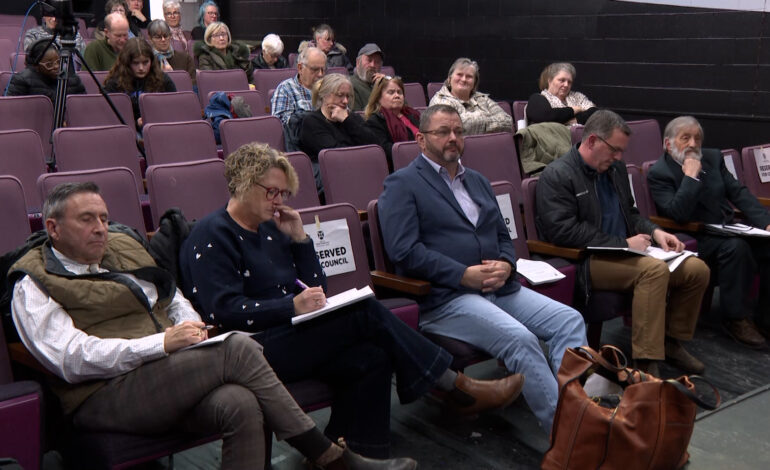
A public hearing of objections on Saint Andrews municipal plan saw residents ask the town not to move forward with its implementation.
A municipal plan is a 10-year guiding document that guides a local government on the future of land use and development and is often complimented by a more specific zoning bylaw.
MP-25 has yet to receive first reading and is in the consultation phase. Changes to the plan can be made up until final reading.
But residents told the council they found the plan difficult to understand and raised concerns about density in the town platt.
Chamcook and Bayside were amalgamated into the Town of Saint Andrews in 2023.
Plan was ‘confusing’
Lee Sochasky, a Saint Andrews resident and former planner, said she believes this is not the right plan for the area.
“Of the municipal plans adopted in New Brunswick recently, and I’ve reviewed many of them, this is by far the least intelligible and functional plan,” she said during the meeting.
She said the plan lacked the why and the prioritization of the varying changes.
“This plan is all arms and legs, going in all directions, sometimes conflicting,” Sochasky said. “It is a distinctly technical and user unfriendly document.”
She said the plan was a risky experiment.
“I object that the plan, unlike our current one, doesn’t recognize and does little to protect the unique national heritage; a critical cornerstone of our identity and our economy,” she said.
Sochasky said she felt there wasn’t enough consultation, although the Southwest New Brunswick Service Commission said there have been 11 public engagement sessions outside of meetings with council and the Planning Advisory Committee.
“There are some good elements in the plan but they’re overshadowed by the major flaws that can significantly and irreversibly affect our town’s future,” she said. “I urge you not to adopt the plan at this time and not shackle in the coming councils with this document.”
Sochasky urged the authors and the town to go back to the drawing board.
Saint Andrews resident Charlie Creaser said the vision of the plan should come before its purpose, noting the direction coming from the provincial government.
“If you’re going to get this right, you better get some things lined up,” he said. “The most important aspect … is the last thing on the list on the left-hand column, which is maintaining the historical significance and the character of the Town of Saint Andrews.”
Creaser said he understands the direction by the province, noting many decisions that have been made are out of the hands of council, but criticized any potential reduction to the heritage of the town.
“The shoulder of that is Bayside and the other shoulder is Chamcook because you have to drive down that road to get here,” he said.
He encouraged the town and the author to reprioritize the historical significance in the plan.
Density and housing
Another major concern raised by residents is density. The plan proposes an increase in the number of dwelling units in the town platt—double the current amount.
The plan’s purpose does outline the creation of housing that meets the needs of all residents, including housing that is affordable.
David Bizzo, also a resident who lives in Saint Andrews, said when he lived in British Columbia, the community he is and his life lived in was “ruined” by urban settlement expansion.
He provided an example of a property on the backside of his on Parr Street, which is slated for multi-residential housing.
“You made a lot a little bigger so they can put two houses there and they’re going to put two families in each house,” he said, noting a member of council who previously advocated for the development of that plot of land. “They’re going to be calling Saint Andrews ‘the subdivision.’”
Bizzo also questioned the ability for the town to keep up with residential growth.

He took aim at an affordable housing complex in Saint Andrews supported by the town on Mowat Drive.
Helen Smith, who has lived in Saint Andrews her whole life, said the town needs housing, especially for business owners who are hiring staff.
“I want to keep my town small, don’t get me wrong here, but we have to have housing,” she said. “Try to hire staff. Try to find them a place to live. We have to have some place for people to go.”
Smith said not everybody can afford to come to Saint Andrews and purchase a home. The average home price in the community is $525,000 in Saint Andrews; and $507,000 in Chamcook and Bayside.
Since 2023, the town has brought online one major apartment—representing 42 units.
According to the 2021 Census data, the average middle household income in Saint Andrews is between $47,493 and $75,988, representing about 20.44 per cent of the working population, and means households in that bracket can afford monthly housing rates between $1,187 and $1,900.
“My kids can’t come here because they can’t afford to live here,” Smith said.
She said running a business is difficult when employees can’t find housing. Saint Andrews sees approximately 80,000 visitors in the summer tourist season, according to Explore NB. Its largest employer is the Algonquin Resort—a premiere destination in the province.
Gillian Pedersen-Mjaanes lives in the downtown core of Saint Andrews and said the zoning bylaw is a dense 69-page document that is difficult to understand.
“It would be great if the town could explain what its vision is for the future of Saint Andrews because I get the impression that they’re jumping on this bandwagon of [density],” she said, speaking with The Courier.
“I urge you not to adopt the plan at this time and not shackle in the coming councils with this document.” – Lee Sochasky
She said she understands the principle of affordable housing, but said the plan doesn’t do a good job of explaining how that is possible, outside of increasing the number of dwelling units on a property.
“I don’t feel that most people would be building affordable housing in their back yard,” she said. “It’d be much more likely if they built anything, it would be a bed and breakfast or an Airbnb.”
In Saint Andrews, the rough estimate of short-term rental (STRs) is around 10 to 11 per cent of the housing stock, according to the town. Statistics Canada said the amount of short-term rentals are higher in tourist-based areas. STRs have increased by more than 60 per cent from 2017 to 2023.
Rural residents, both of Chamcook and Bayside, feel there are far more restrictions in the area than ever before. Both areas were subject to a rural plan, but are now being brought into the municipality under its governance.
Rural areas raise concerns
Gary James said he found the plan sporadic, adding he felt perhaps there needed to be more research done to help inform the plan.
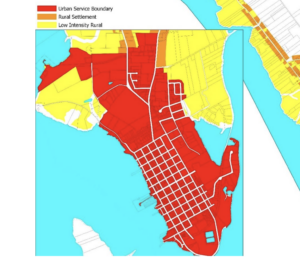
“It looks like someone took a highlighter and coloured different areas and said this is this,” he said during the meeting. “I look at my property and I look at my neighbours property and it’s totally different and I’m going, ‘What is the difference between my neighbours and me?’”
Craig Smith, who has lived in Saint Andrews his whole life, said the town needed to “pump the breaks” on the plan.
“Given what happened with the market, the egg on our face, the way we looked across Canada, we need to stop [and] listen to what everybody is saying and maybe come back to this at some other point down the road,” he said.
Rural resident Jeff Muir said he didn’t care what the province’s mandate was and that he felt this plan was not right for the rural amalgamated areas.
He said when he came from his job as a long-haul truck operator, he was met with a plan that seemed like a done deal.
“I don’t think you have it, I’m concerned you’re never going to have it … none of this makes any sense,” he said.
Deputy Mayor Kate Akagi said council has not met since the public hearing.
“It’s not great to hear that we’re not doing the proper things, but we’re trying to do the proper things with what we’ve got left with our mandate,” she said, with an election happening in May.
She said it was difficult to be accused of not doing this right because the council really wants what is best for the residents of Saint Andrews.
The council was not allowed to respond or debate during the public hearing of objections.
“This is only a draft,” she said. “That’s what kills me, is it’s not the final copy. It’s not exactly like the old one, definitely not, but that was the mandate that we started with.”
Akagi said Wednesday night was a good opportunity to hear residents’ concerns, adding the plan is a working document that can be changed. She expects the council to come back with some answers in early March.
The Department of Local Government said the Community Planning Act (CPA) sets out the standards for content and the process required when developing a municipal or rural plan.
“The Department of Environment and Local Government reviews these plans to ensure they meet the Act’s minimum requirements,” the department said. “If a municipal plan or rural plan complies with the Act, the department grants approval.”
According to the CPA, a municipal plan shall—which is often interpreted as a mandatory—should include statements of policy around housing—including affordable and rental housing, urban renewal, and preservation of buildings and sites of historical interest, among others.