

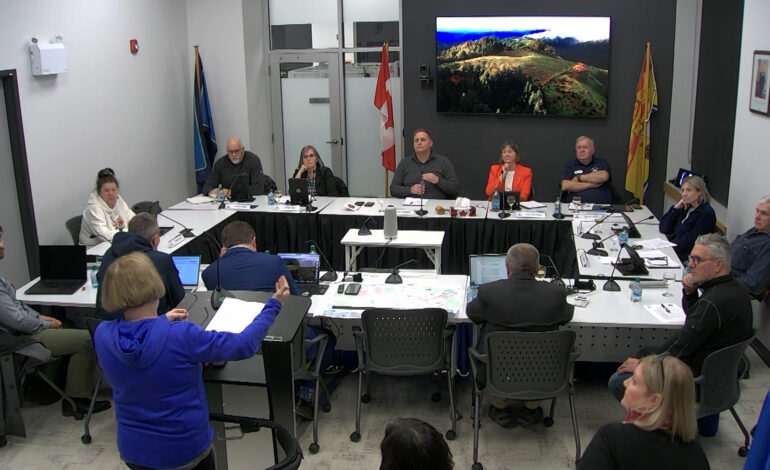
The Municipal District of St. Stephen (MDSS) has decided not to change the public comment period from its regular meetings.
A public comment period is held toward the beginning of the meeting, allowing individuals to speak and ask questions, though the council cannot respond or enter into debate.
Chief Administrative Officer Jeff Renaud offered change to the council through three options but said staff was not making a recommendation because the decision must be made by the councillors.
Some of the options included pre-registration prior to the meeting, eliminating it all together, and not broadcasting or recording it.
“We wanted to make sure that this came to this council, you have three options there of varying styles,” Renaud told the council. “Administration is looking for direction or if there is a preferred style there … or if you just want to keep things how they are, just feedback for us so we know where to direct our energies.”
Many councillors expressed a desire for change. The municipality has been open about facing harassment in recent months and issued a statement in August 2025.
Not the right time
Coun. Joyce Wright said she prefers a one-on-one discussion outside of a council meeting.
“Every time I’ve offered to meet with someone and have a coffee when there [are] concerns, I never get taken up on that,” she said, during the meeting. “We need to foster [a community that] reaches out to their councillors just like they do their MLA, just like they do with their MP.”
She said although she felt something needed to change, the timing was not right.
“I’m going to throw a bombshell here, I think we were late to the game in doing it,” Wright said. “If we were going to do this as this council, I would want to see us do it in a time frame that allows … for the public to see the benefits of it, to see the results of it.”
Wright pointed to the fact that councils across the province are nearing the end of their terms, with an election scheduled May 11.
“While I agree changes need to be made, I’m not sure now is the time to make them,” she said.
Coun. David Hyslop said he agreed with Wright, noting this council would be unlikely to see the benefits and could create a challenge for the incoming council, depending on how it wants the meetings to operate.
Hyslop and Coun. Marg Harding both sat on the council that brought a public comment period to regular council meetings.
“It was before all the cameras, and everything, and it was a pretty open conversation,” he said. “I like to see [the] comment period before decisions are made.”
He believed the public comment period should move to Committee of the Whole— a meeting where council discusses reports, policies with staff in a less formal manner—which would allow him more insight into how the community feels before casting his vote on an issue.
“It used to be … everybody turned around and said ‘do you have any questions’ after every committee presented and that is how it went, it was pretty easy-going, but then when you’ve got cameras on you, we don’t talk as openly as what we used to … because you’ve got cameras because you’ve got people watching us and taking it out context,” he said.
Hyslop said people have published parts of videos out of context, which has led to harassment of him and his family.
“I’ve got 300 messages on my phone that are disgusting—that attack me and attack my wife for something that was never said at a council meeting,” he said. “So something has got to change.”
Hyslop said he doesn’t believe it is the right time to make the change so close to an election.
CHCO-TV, which is owner of The Courier, provides an operator for the camera system at the Garcelon Civic Centre. Those meetings are broadcast on television and posted to YouTube.
Mayor Allan MacEachern said in the past, the public comment period was about something specific—an issue an individual was passionate about—but said that it has become individuals who persistently come to the podium.
“A lot of these questions deserve a lot of dialogue and you can’t do that in the two minutes either,” he said. “My goal was to, hopefully, pave the way for the new council.”
Coun. Wade Greenlaw said he agreed with Hyslop that the public comment period should be moved to Committee of the Whole, where much of the debate and discussion around policy decisions takes place.
“I feel that any feedback from the community is valuable in any format,” he said during the meeting, adding he believed the podium provides people with a stronger impact than an email or a one-on-one conversation.
Greenlaw said he felt the public comment period needed to be kept, but thinks it should be more meaningful, in the form of town halls—an informal meeting where a dialogue can be held between council and the public on a particular issue.
Coun. Marg Harding has been around the horseshoe for a little more than two decades. She said people come to her all the time in regards to issues within the municipality. She said if you keep pushing people to come speak to you on an individual basis, they will come in time.
MacEachern said he understands the frustration by the public who are looking for a dialogue and a response to their questions.
“It just ends there, and it’s dead air, and we go back into our meeting,” he said.
Renaud explained to the council, a newly hired communications officer would be part of how it moves forward with public engagement, including public comment period.
Coun. Brian Cornish said he agrees this council shouldn’t be the one to decide. He said it shouldn’t be about controlling it, but managing it effectively when it does get out of hand.
The council ultimately decided not to move forward with any changes. Renaud said the dialogue will be carried forward to the new council.
‘The public won’t stand for it’
Geoff Martin, an assistant professor at Mount Allison University, said the administration should look to see if what they are proposing is legally allowed, like preventing people from filming a public meeting.
“I’m not a lawyer, but I think the answer is probably no,” he said, speaking to The Courier.
He said it is often easier for municipalities to operate in closed because people don’t really know what is going on.
“You can kind of say: oh, well, [the public] can come and vote in three or four years based on the results we get and so on. But you know, we don’t really want to hear from you, or we [only] want you to communicate with us only in the ways that suit us,” he said.
He said some of the strife comes from the amalgamation of communities not previously included in municipalities—who feel like they have been taken over by a level of government they didn’t necessarily want—who may be unfamiliar with that type of governance.
“I think in that environment, I think there has to be greater sensitivity,” he said. “To be careful with how things are done, and being more than willing to show that things are being done in [an] efficient way and that the municipality is open to hearing from the people, and is open to providing explanations for what they’re doing.”
Martin said when questions become repetitive on a single issue then it is up to the chair to handle it appropriately.
Public life, he explained, is just that—public.
“If you want to go into public life, you need to choose your words carefully. You need to plan on how you’re going to communicate,” he said.
Martin said he recognizes that municipal officials are facing more scrutiny than before, but there should be proper resources to deal with the small population of people who go over the line.
“It doesn’t necessarily justify, sort of, shutting down the communications or things like that,” he said. “It certainly is a challenge for people in public life.”
St. Thomas University Public Policy professor Jamie Gillies said this is a moment in time where people wished to be heard, but also one that has brought safety concerns to the front doors of municipal leaders.
“So you can see the pressure on council to try to limit public comment or get people to register in advance so they know what is going to be on the agenda,” he said, speaking to The Courier.
Gillies said this also coincides with a desire for councils to be more transparent, accountable and accessible to the public.
He said an issue that is being pushed by the public can often become heated and animated, taking resources away from other topics the council needs to deal with.
“But trying to limit public debate is a very difficult thing to do, because the public won’t stand for it,” Gillies said, adding there are likely things council can do procedurally to make the discussion more fruitful and bring decorum back to the kind of discussions seen at the local level.