


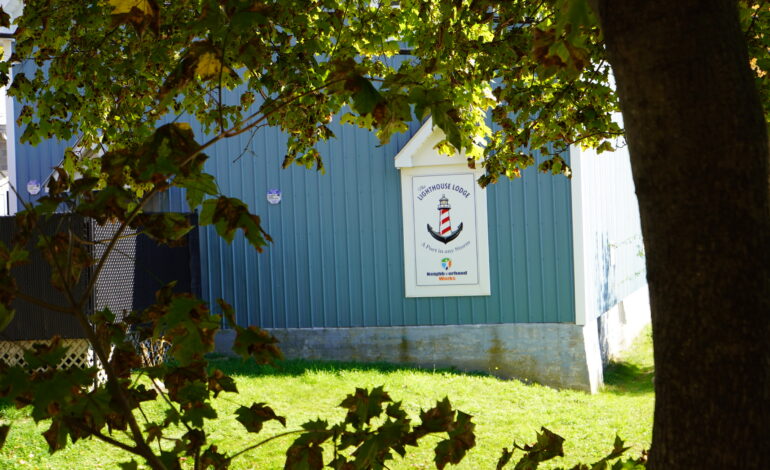
The Municipal District of St. Stephen (MDSS) has voted unanimously to reject a bridge housing project at 199 Union Street, proposed by Neighbourhood Works Inc., the non-profit operator of the shelter in the community.
Over the last several years, the community has faced significant challenges related to the homelessness crisis. It is estimated that around 100 people are unhoused in the community.
Mayor Allan MacEachern told the public in attendance at the meeting, the council had received a proposal for a bridge housing project at 199 Union Street—a property about two kilometres away from Milltown Blvd.
“We got correspondence from them and many others,” he said. “The very common theme is wanting to understand the process of how we’re going to alleviate the situation we’re in. Most of them said we need to do something and this council, I believe, supports that as well.”
MacEachern said concerns were also raised at a municipal building—used by public works and the fire department—and that relocating the equipment and the building would cost a significant amount.
He said he has asked the province to come speak to the community directly.
“Because capitulation means death for people, and that is unacceptable, and it also means that we’re not living up to its obligation to provide housing as a right.” – Tobin LeBlanc Haley
Jim Stuart, the executive director of Neighbourhood Works Inc., spoke to the council during the public comment period.
“No community wants a shelter,” he said. “If there is no pathway forward, the shelter does not disappear, it becomes permanent by default.”
Stuart said bridge housing ensures that shelters—like the one on Main Street—are only temporary by providing housing that enables individuals to feel safe and supported.
“Ending homelessness does not end by wishing it away, it doesn’t happen by closing doors, it happens by building a pathway out, step-by-step, person-by-person,” he said.
He told the council if the mutual goal is to end homelessness, bridge housing could not be seen as optional.
What the data shows
The last point in time (PiT) count conducted by the Human Development Council (HDC) for the smaller communities in New Brunswick was in November 2024. Those communities included three Charlotte County communities, St. George, St. Stephen and Grand Manan, alongside Sitansisk First Nation (St. Mary’s), Miramichi, Sussex, Edmundston, Grand Falls, Nackawic, Woodstock, Perth Andover, Neqotkuk First Nation (Tobique), and Plaster Rock.
The data does not distinguish between communities but provides a snapshot of them as a whole.
About 233 people were considered homeless in those communities, with 61 per cent were considered chronically homeless, for more than 180 days.
It said 69 per cent were men, 26 per cent were women, and 5 per cent identified as other.
The average age was 31 years old, but the highest percentage of people experiencing homelessness in these communities was under the age of 18. Twenty-four per cent of them had reported living in foster care.
Forty-nine per cent had reported always being in the community, while 51 per cent reported moving to the community.
An earlier study, in 2023 that surveyed 687 people experiencing homelessness found that 576 of them reported being in Saint John, Fredericton, Moncton, Miramichi, and St. Stephen.
The community has been vocal about issues it is facing due to the homelessness crisis, reporting witnessing moments of extreme violence, drug use, and deals outside the Lighthouse Lodge.
In October, Peter Fitch and Stacy Arsenault presented to council and asked for the creation of a well-being task force, to relocate the shelter, and increased bylaw enforcement.
Since then, the task force was created, and the first meeting could not reach quorum. A motion to relocate the shelter was ultimately defeated by a vote of the council.
Council discussion
Coin. Joyce Wright said she based her vote on the operational impact to municipal infrastructure.
“We need to do something,” she said. “We can’t say we want to eliminate homelessness and not allow any other options that let us get to the point where we can do that.”
Wright said pushing people to use resources in another community won’t solve it either.
“We need to be willing to step up and do it, and the statistics show that we are serving people from our community, people we went to school with, people we’ve maybe worked with, people we have grown up around.”
Coun. Marg Harding said she responded to a lot of people who reached out to her.
“The people of St. Stephen are great people and they’re not mean, they’re not nasty, they’re not anything … they want to see people get help and unless people get help in this area, nothing is ever going to change,” she said, which was met with applause.
Coun. Brian Cornish said it had been four years since the municipality had declared a state of emergency over the growing number of people experiencing homelessness in the community.
“The bottom line is I don’t know the [credibility] for the people that are running it, I don’t know the process of what is going through those buildings,” he said.
Coun. Emily Rodas said the council received 39 printed pages of emails. She said a lot of it was a desire to understand the recovery process within the transitional housing project.
Rodas explained NWI works with the funding it receives from the provincial government—the level of government mandated to deal with housing and homelessness.
“There needs to be something that’s long term,” she said. “We need to hear more from them. We need more of a commitment.” – Ward 3 Resident Chandra Best
Community concerns in those emails ranged from wanting 24/7 on site security, a greater understanding of detox and treatment options, a change in operator, and spill-over impacts into the community.
Chandra Best, who lives in Ward 3—a rural section of the municipality—said community members are tired, scared, and worried.
“It’s been going on for too long,” she said, speaking to The Courier. “People are exhausted, and people can’t even sell their homes anymore, because the value of their property is decreasing because of the stigma associated with what’s going on around here.”
She described the situation as sad and concerning, not just for those who are unhoused and are facing addiction, but for the community members who experience the impacts of homelessness.
Best said the community wants to be informed and brought along through the process to understand the path forward.
“Make sure that we have all the information that we [need] to understand, not just what’s going on today, but what is the plan. You can’t have phase one of a plan if you don’t have phase two and phase three. So, bring us along so that we can understand what’s going on,” she said.
It is hard to be hopeful, she said, without a message or plan that conveys that feeling. Best believes the province is only providing band-aid solutions.
“There needs to be something that’s long term,” she said. “We need to hear more from them. We need more of a commitment.”
Best said there is only so much the municipality can do given the constraints of their mandate at the local level.
“Things need to change at every level, and I feel like [the] municipal government is just struggling along at sort of the bottom of the food chain, so to speak,” she said. “We have to remember that we have to be compassionate for everybody, not just the addicts, not just the homeless, but all of us in the community, and to try to find the common ground.”
She added finding that common ground might prove to be the most difficult part.
‘People are dying’
Tobin LeBlanc Haley, a professor at the University of New Brunswick in the Department of Social Sciences, said good faith consultation has a role to play in addressing the changing dynamics of neighbourhoods.
“I think one thing that municipal governments or any level of government can do in these consultations is to provide an open space for dialogue and for people to ask questions and for information to be provided,” she said, speaking to The Courier. “There is always a risk, however, that it provides a site of organizing against critical infrastructure in a community.”
LeBlanc Haley said a renowned Canadian housing researcher Carolyn Whitman said “you have the right to housing, you don’t have the right to choose your neighbour.”
“People are dying. People don’t have a place to live. It is freezing right now. This is critical life saving infrastructure that will only strengthen our communities,” LeBlanc Haley said.
She understands the struggle to deal with the changing dynamics of a community, however, being unhoused is not a personal failure but a structural one.
Ultimately, LeBlanc Haley said top down education has proven not to be effective, but open consultation is an important component.
“I also think that decision makers just have to do it. You just have to do it. These are elected officials. Their job is to protect the public,” she said.
She said leaders must do what is right, but also evidence-based.
“We know that people are dying … homelessness is a policy failure, it is not personal failure. So there needs to be a policy correction, and a critical part of that policy correction is transitional housing, shelters, more supportive housing, more public housing,” LeBlanc Haley said.
She said what people are struggling with is the visibility of homelessness, but once individuals are provided appropriate housing and support, that goes away.
The housing-first model has shown high rates of success in Canada, according to the Canadian Centre for Addiction and Mental Health (CAMH). A study conducted in partnership with St. Micheal’s Hospital followed a group of unhoused people for six years, those who were using the HF model had stable housing an average of 85 per cent of the time in the previous year, compared to 60 per cent for those without that model.
LeBlanc Haley said elected officials must demonstrate leadership, not capitulation.
“Because capitulation means death for people, and that is unacceptable, and it also means that we’re not living up to its obligation to provide housing as a right,” she said.
Minister responsible for housing David Hickey said it has learned its lesson on meaningful consultation. Hickey spoke with Mayor Allan MacEachern earlier this week and told him the province needs a bridge housing project in St. Stephen.
“We need a solution to the shelter situation in St. Stephen and we have the funding … to do it at this moment,” he said. “We need to be able to deliver on that quickly.”
He said if the municipality can commit to finding a location, the province will begin its partnership with whatever operator that is going to lead it.
“We’ll start making sure we’re buying the infrastructure,” he said, adding it wants to move forward with the funding so when the right site is identified, the province can move quickly.
“At the end of the day, it means we need the municipality to commit to finding us the right location,” Hickey said.
Hickey said there is an urgency to distribute the $7.4 million before the end of the fiscal year, which is typically in March. Neighbourhood Works Inc., the operator of the Lighthouse Lodge in St. Stephen, submitted a 17-page proposal to the council for consideration in November 2025.
MacEachern said he hopes a new location for the proposed project can be found in a matter of days, not months.


