

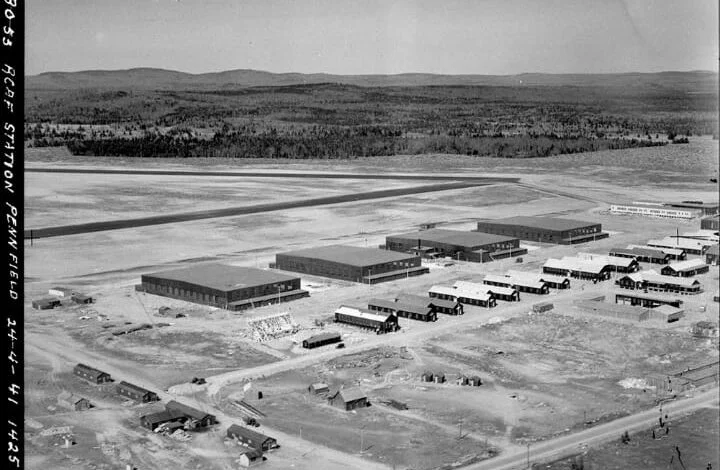
The period between May 18, 1942 and August 31, 1942 was a complex and confusing time for the Pennfield Ridge Air Station (PRAS) – No. 2 Air Navigation School (ANS) ceased operations May 30th; No. 34 Operational Training Unit (OTU) moved here on a “temporary” basis from Yarmouth, NS between May 18th and May 27th and No. 2 Operational Training Unit was to commence formation effective July 6th. Personnel began arriving in Pennfield Ridge as early as June 22nd – but No. 2 OTU never came to fruition. A phone call was received on July 18th “…advising suspension of the formation of No. 2 OTU…” owing to the unexpected delays in the delivery of aircraft.
No. 34 OTU was expected to return to Yarmouth in September 1942 so until then No. 2 OTU’s personnel were not to exceed 50 officers, 100 Senior Non Commissioned Officers (NCO’s) and 700 Other Ranks (OR).
By June 30th the strength of the unit stood at 236 and when the first Daily Routine Orders (DROs) were published on July 7th, the numbers “…increased by the addition of 5 officers, 2 nursing sisters and 128 airmen, all Royal Canadian Air Force (RCAF) who had been attached to No. 34 OTU upon the disbanding of No. 2 Air Navigation School.” By July 19th, one day after the suspension of the formation of No. 2 OTU, the strength had reached 905.
As the cooks and security guards were the only airmen for whom employment could be found, it was necessary to plan and carry out a programme of daily drilling, route marches, games, etc., to keep the airmen occupied. Also, it was necessary to accommodate over 400 airmen in the Drill Hall; as well, additional sanitary buildings were constructed east of the Drill Hall.
Posting out of airmen commenced on July 29th and concluded on August 19th. The delay in postings caused an “…adverse effect on interest and morale caused by the continued unemployment”. Additionally, the “…posting of eleven airmen was delayed for a few days owing to their lack of funds to provide transportation for the wives and families brought with them on posting”.
A few of those airmen:
1. Sgt. William John Anderson DUNNING (R/65243) (Armourer) – posted 11 August 1942 to RCAF Station, Sydney, NS where he was subsequently killed 15 February 1945 (age 29) in an explosion in No. 4 Hanger at 0910 hours.
2. Sgt. Edward John BALLINGER, Mentioned In Despatches (MiD)* (R/78308) (Cook) who left us in May 2009 (age 95).
*”MiD” – a military honour awarded to subordinate personnel for gallant or meritorious service in action.
A baker before the war, Ballinger enlisted as a cook, serving at No. 8 Service Flying Training Schools (SFTS), Moncton 15 January 1941 to 08 May 1942, promoted Corporal, 03 June 1942; then to No. 2 OTU, Pennfield Ridge 25 June to 25 July 1942, No. 1 OTU, Bagotville 26 July to 01 September 1942 and then posted overseas, arriving in Britain on 09 October 1942. Posted to No. 425 Squadron, 26 October 1942.
Posted to Station Dunsfold, 12 January 1943; attended RAF School of Cookery, 27 January 1943; then to No 129 Airfield, 10 July 1943 (reclassified as chef, 01 July 1943); to France, 25 June 1944; to No.406 Air Stores Park, 28 July 1944 to 19 December 1945; embarked from Ostend, 20 December 1945 for UK; repatriated to Canada, 15 February 1946; released 5 March 1946.
His MiD “for gallant or meritorious service in action” was effective 01 January 1946 as per the London Gazette of that date. Sadly, there was no citation cited for this award.
3. Cpl. George Robert EBBS (R/67132) (Instrument Maker) – one of the 134 airmen posted to Bagotville, QC 21 July 1942 where he succumbed to spinal meningitis 12 September 1942.
4. Sgt. Peter Edward GALGAN (R/128183) (Armourer) – posted to Mont Joli, QC; Uplands, ON; Mountain View, ON; and finally Dafoe, SK 03 February 1943. Killed as a result of an aircraft accident 26 November 1943, 8 miles north of Leroy, SK, on a routine training flight.
5. Theodore Michael (Ted) HATTY (Leading Aircraftman) (LAC) (R/126282) who left us 18 February 2014, just two days after his 94th birthday.
6. John Bruce McGOVERN (Warrant Officer) (W/O) (R/105460) (Standard Duty Guard) enlisted in the RCAF 03 June 1941. Posted to No. 2 ANS, Pennfield Ridge 22 July 1941 to 27 May 1942; No. 34 OTU, Pennfield Ridge 28 May 1942 to 06 July 1942; and No. 2 OTU, Pennfield Ridge 07 July 1942 to 20 July 1942; No. 34 OTU, Pennfield Ridge 20 July 194 to 07 November 1942.
Remustered to Air Crew and trained as an Air Gunner (AG) at Mont Joli, PQ where he was awarded his AG Badge 05 February 1943. Then posted to No. 34 OTU, Pennfield Ridge 20 February 1943 15 May 1943 as part of Course No. 8 (AG). On 22 March 1943 was moved to Course No.9 (AG). Eventually posted to 196 Royal Air Force (RAF) Squadron.
Killed 21 February 1945 when Stirling LK 126* was shot down by a Ju88* over Shepherd’s Grove, UK.
*The Stirling was the first four-engined bomber operated by the RAF in World War II.
*The Junkers Ju 88 was a twin-engined multirole combat aircraft designed and produced by the German aircraft manufacturer Junkers Aircraft and Motor Works.
7. S/L Herbert John Campbell RUSSELL (C/9370) (Flight Engineer) who took his final flight 30 September 2011.
Educated in St. John’s and in England, following university graduation as an aeronautical engineer, Mr. Russell joined the Royal Air Force at the beginning of World War II. A proud Canadian, he subsequently returned home to join the Royal Canadian Air Force. Following his distinguished wartime service, Mr. Russell joined the Industrial Development Bank and retired as a senior executive officer from its successor, the Federal Business Development Bank.
So “The School That Never Existed” remains as a footnote in the history books of the Pennfield Ridge Air Station and a fleeting memory in the minds of those who served here.
postscript: An example of another airman who trained at PRAS was Flight Lieutenant (F/L) Jack Mills ANGUISH (J/8435), MiD who became a Flying Control Officer (FCO) after being grounded from aircrew for medical reasons. His citation reads, “While not robust physically, this officer has never spared himself and has been outstanding in his devotion to duty. Flight Lieutenant Anguish has done especially good work over the past year in training new control officers and in helping other ranks in Flying Control in their studies to attain higher groupings in their trade. Altogether an outstanding officer and man.”
There were 73 airmen who passed through PRAS who were awarded the MiD – 60 Canadians, 12 British and 1 Australian. One was awarded it twice and another three times. This further attests to the high calibre of Canadians in service at Pennfield Ridge.
The senior Canadian officer involved in active operations may recommend that subordinate individuals receive public recognition for valiant conduct, devotion to duty or other distinguished service by formally mentioning them in dispatches. If approved, public recognition is granted by the award of a MiD insignia and the publication of appropriate details in the Canada Gazette. A recipient of a mention in a dispatch is entitled to wear an emblem in the form of an oak leaf on the ribbon of the relevant campaign medal. They are also issued with an official certificate from the Ministry of Defence.
 Christian Larsen currently serves as President of Pennfield Parish Military Historical Society. He has been actively involved in researching the genealogical & military history of Pennfield Parish for nearly four decades. From 2009 until 2017 he hosted the annual Pennfield Ridge War Memorial Services. Recognized at the provincial & federal levels for his work with Veterans having been awarded the Queen Elizabeth II’s Diamond Jubilee Medal (2012); Queen Elizabeth II’s Platinum Jubilee Medal (2023); Minister of Veteran Affairs Commendation (2024) & King Charles III’s Coronation Medal (2025). He can be reached at: ppmhsociety@gmail.com