

John Chilibeck, Local Journalism Initiative Reporter
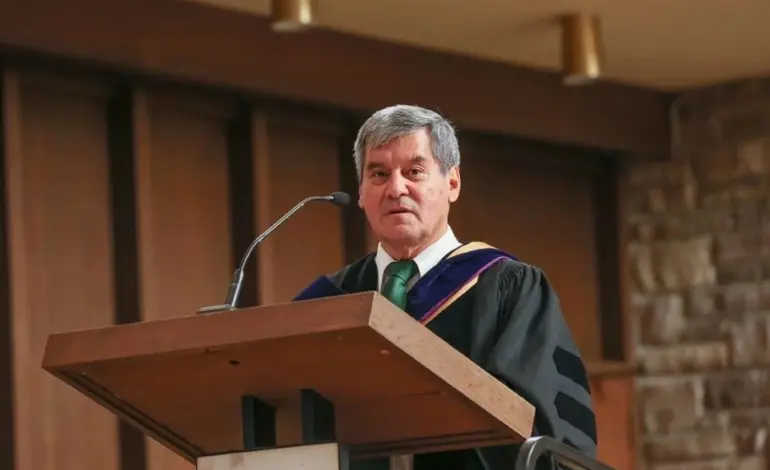
Graydon Nicholas, New Brunswick’s first Indigenous person to serve as lieutenant governor, has been awarded one of the highest honours bestowed by the Knights of Columbus, the world’s largest Catholic fraternal organization.
Earlier this month, in Denver, Colorado, Nicholas was presented with the Caritas Award, a rare international honour that the group bestows for what it considers extraordinary acts of charity, service and sacrifice for the good of others.
A large part of Nicholas’s service was trying to bridge the gap between some of the misdeeds of the Catholic Church in the past and reconciliation with Indigenous peoples.
Supreme Knight Patrick Kelly told the crowd at the 144th annual convention on Aug. 5 that Nicholas, who was the first Indigenous person in New Brunswick to obtain a law degree, serve as a judge and become the monarchy’s representative, and played an integral role in the development of the organization’s Native American Solidarity Initiative, launched in 2019.
“Throughout his career as a lawyer, judge, government official and college professor, he has worked for the Indigenous peoples of Canada, promoting their causes and protecting their rights,” Kelly said, using the familiar term of college in America to describe what Canadians would call a university. Nicholas was a professor and chancellor at St. Thomas University in Fredericton.
The Knights, open to Catholic men 18 years and older, have more than 2.1 million members worldwide, 200,000 of them in Canada. But you don’t have to be a Knight to win its prestigious award.
Nicholas grew up attending St. Anne’s Church in Tobique First Nation, or Neqotkuk in the Wolastoqey language, where he was an altar boy and taught in school by nuns. He was thrilled with the citation.
A Caritas isn’t awarded every year and has only been bestowed on seven people since it was first introduced in 2013.
A previous winner was Msgr. Robert Weiss, pastor of St. Rose of Lima Church and St. Virgilius Council No. 185 in Newtown, Connecticut, in recognition of their service in helping that community heal and recover from the Sandy Hook Elementary School shooting that left 26 people dead.
Nicholas, 80, said he was happy that the Native American Solidarity Initiative was also getting more recognition.
“This initiative by the Knights came about through many things,” he told Brunswick News in an interview earlier this week.
“It goes back a long time and how the early Catholic Church was involved in colonization, as well as European powers. And so, the damages that would result was not just in the Americas, but throughout the world as well where there were Indigenous people. So that’s the basis of this, to come to terms with this. What could the Knights do to facilitate a better relationship with the church and the needs of its people?
“It’s a great initiative.”
He said one of his greatest hopes would be to convince the Catholic church to canonize more Indigenous saints, such as Antonio Cuipa, an Apalachee leader and catechist in Spanish Florida who was martyred in 1704 alongside companions during raids against mission settlements.
Nicholas has served with the upper hierarchy of the Knights since 2015, when he was elected to the organization’s supreme council. He then became a board member emeritus, and finally, a consultant on Canadian and Indigenous issues.
In his time at the top, he’s met with two popes, Benedict XVI and Pope Leo XIV.
But he also enjoys meeting with laypersons, including the congregation at St. Mary Magdalene Parish in Fredericton, where he attends mass with his wife most Sundays.
The resolution passed by the Knights in 2019 for the solidarity initiative speaks at length of the Catholic church’s at times fraught relationship with Indigenous people, including its role in the residential school system, in existence for more than a century, which separated children from their families and sought to destroy much of their culture.
But it also pays respect to the 400 years of Catholic faith shared with Indigenous people and a promise to do better.
For Nicholas, that means the world to him.
“Not every Indigenous person is Catholic in this country. They might belong for different Christian faiths, or they might not even belong to a Christian faith. But the efforts of those of us involved have been instrumental in making a difference.”