


On a Thursday afternoon in August, Toronto Raptors legend Jamaal Magloire stood on the world’s oldest surviving basketball court, holding a ball directly over the basket.
There was no need to jump. No dramatic leap. No slam dunk. The former NBA All-Star could simply extend his arms and place the ball inside with his hands.
At that instant, one could see over 130 years of basketball evolution. The game had grown taller and faster. It had crossed borders, filled arenas, created global stars, and opened itself to players who once would have been excluded. The goal was still to put a ball in a basket. Almost everything around it had changed.
Magloire, the first Canadian-born player to suit up for the Toronto Raptors, had never visited St. Stephen, New Brunswick, before his induction into the Canadian Basketball Hall of Fame (CBHF) in 2026. Basketball had taken him from Scarborough to the NBA All-Star Game. Now it had brought him to this small town on the New Brunswick-Maine border for one of the greatest honours of his career.
“Coming to see the world’s oldest basketball court is very probably going to be the highlight of my trip,” he said, speaking with The Courier. “It was a privilege and an honour to see where it all started.”
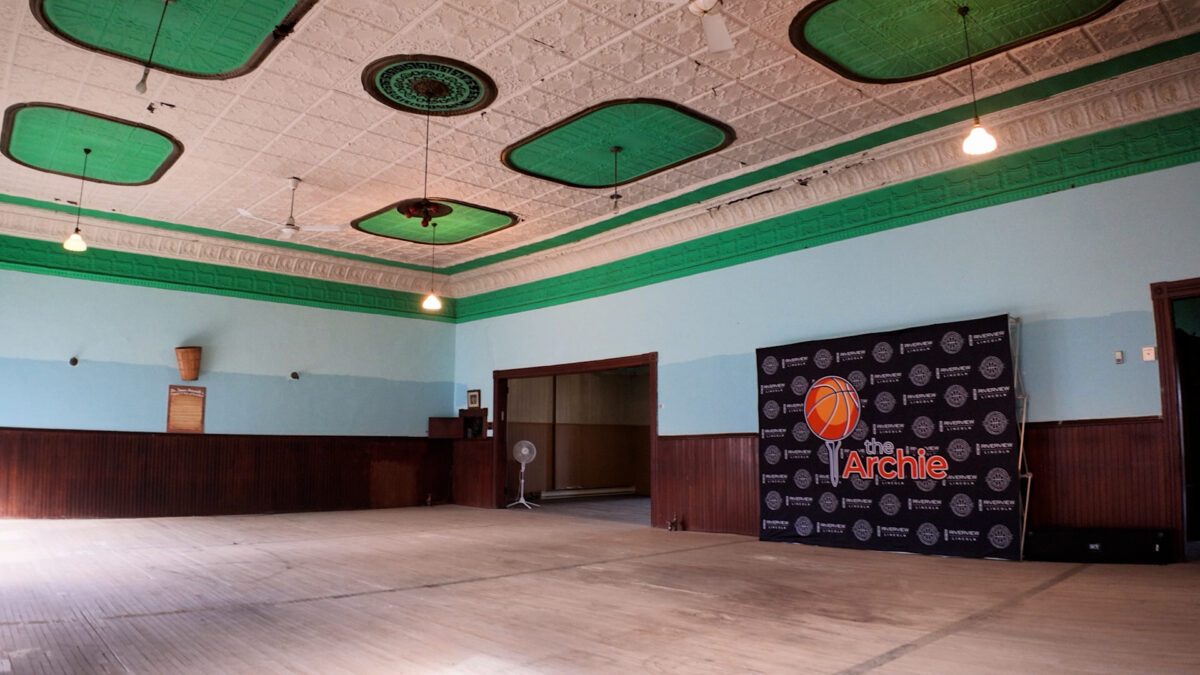
His visit followed years of work in southwest New Brunswick. For the past five years, The Archie, a celebrity golf tournament named for the man who brought basketball to town, had raised money and drawn attention to the surviving court and plans for its future. Canada Basketball had supported the event since its inception. In 2026, it chose St. Stephen for its Hall of Fame induction, bringing the ceremony to Atlantic Canada for the first time.
The largest induction class in the Hall’s history was coming to a town whose place in the game had nearly been forgotten. Joining Magloire in the 10-member class were fellow players Miranda Ayim, Michael Meeks, Anna Stammberger, Dan Meagher and Teresa Kleindienst; coaches Peter “Doc” Ryan and Dave Smart; official Janice Deakin; and builder Dr. Andrew Pipe.
Before the ceremony at the Garcelon Civic Centre, inductees came downtown to meet the community. Fans lined up inside the old court for photographs and autographs. Outside, basketballs struck the pavement as kids played beneath nets. Music carried up from the waterfront.
For one day in the final weeks of summer, a street party took over King Street, and the average height of downtown St. Stephen increased considerably.
Magloire walked through town square, stopping for photographs. Nearby, Canadian rap icon Maestro Fresh Wes was preparing to celebrate his longtime friend and fellow Scarborough native.
“He’s the Raptor. I’m the rapper,” Maestro said with pride.
Raptors broadcaster Paul Jones moved through the crowd before heading to the Garcelon to host the induction. A few doors away, architectural historian John Leroux led visitors upstairs to the floor that had brought everyone here. That evening, Grammy and Juno Award winner Chantal Kreviazuk sang “O Canada” before the inductees took their places in the Hall of Fame.
To understand why they came to St. Stephen, one would have to go back to a young man named Lyman Archibald.
Canadian James Naismith invented basketball in Springfield, Massachusetts, in 1891. Archibald, a Nova Scotian, played on Naismith’s original team. When he was hired by the St. Stephen YMCA in 1893, he brought the new game with him.
We know when it arrived because The Saint Croix Courier wrote it down.
On Oct. 17, 1893, the newspaper reported that “basket ball” had been played upstairs at the YMCA. There were no billion-dollar franchises, sneaker empires or Hall of Fame ceremonies. Baskets still had bottoms, so someone had to retrieve the ball after every successful shot.
Early basketball rewarded accuracy with labour.

The YMCA building had risen after an 1877 fire destroyed more than 80 homes and businesses downtown. Basketball arrived as St. Stephen was rebuilding, and people gathered to play on the hardwood upstairs. After the YMCA closed, carpet covered the old gymnasium. Generations walked across it, unaware of what lay beneath.
Then, in May 2010, fire struck the building again.
During the cleanup, workers pulled back the carpet and exposed the athletic floor. The fire revealed the court, but it could not explain what they found. For that, researchers turned to The Courier’s archives.
There they found the 1893 report placing basketball in that room six weeks before a recorded game on the Paris, France, court previously believed to be the oldest surviving court in the world.
St. Stephen defeated Paris without the inconvenience of playing them — arguably Charlotte County’s greatest sporting victory.
The first court in Springfield no longer exists. The floor in St. Stephen does.
“The Courier has been the documentation and the history book for St. Stephen,” Mayor Steve Backman said. “If it wasn’t for finding that old issue of The Courier, we would never have known.”
A few lines in a local newspaper had survived long enough to change how the town understood an entire building.
Backman describes St. Stephen and Calais as “one community divided by a river.” A Canadian invented basketball in Massachusetts, a Nova Scotian carried it to New Brunswick, and New Brunswickers played it here against people from Maine. The sport crossed borders almost from the beginning.
Leading tours upstairs, Leroux called the court the “Taj Mahal of basketball.”
“Great things can come from small places,” he said. “It’s not about the size of the place.”
Meeks, who represented Canada at the 2000 Olympic Games and led the national team in scoring, tried to picture the game’s earliest players in that room. He had competed on courts around the world. This one asked him to imagine a game he had never seen.
“You see the size of it and try to imagine how the game was actually played,” he said. “Because I know the game today.”
The Hall of Famers walking across that small floor reflected how far basketball had travelled. The children playing outside gave a glimpse of where it might go.
For St. Stephen, that future is taking shape around the court itself.

“The Raptors won a championship in 2019. Now there’s Raptors 905, the Toronto Tempo and the Canadian Elite Basketball League. There’s so much more opportunity in the game,” Magloire told The Courier. “I hope one day we have a Hall of Fame that’s in stone, that has a home. I believe this would be a beautiful place to have it.”
The proposed $18-million Canada First Basketball Experience Centre, designed by CambridgeSeven, would preserve the court while featuring exhibits, artifacts and interactive experiences about basketball’s place in Canada. Backman believes it could attract as many as 20,000 visitors a year to St. Stephen.
But a historic court, however remarkable, cannot introduce itself to the basketball world. People have to bring that world to its door.
Enter Tom Liston. A key member of the court’s board and a New Brunswicker splitting time between the Maritimes and Toronto, Liston helped build the board’s relationship with Canada Basketball through The Archie. Before the induction, he hoped St. Stephen’s welcome might make the Hall of Fame want to return.
“What we’d like to do is impress them enough that maybe they could come back a few times,” he told The Courier. “They haven’t committed yet, but we’ll try to wow them so that they’ll hopefully start to think of us as the default when they decide where to hold it.”
By the end of the evening, Canada Basketball president and CEO Michael Bartlett had confirmed that the Hall of Fame would return to St. Stephen for its next induction in 2028. The Hall now celebrates its inductees at a live ceremony every two years; the next one will follow the Los Angeles Olympics that summer.
From the stage, Bartlett made clear how much of the occasion Liston had set in motion.
“Tom is the reason many of you are here,” he told the audience. “His passion for hoops, history, New Brunswick, Canada, and people is what connects him to all of us.”
Bartlett recalled the winter phone call when they first conceived a plan to bring the ceremony to St. Stephen. Liston, he said, had made his mission plain: if Canada Basketball came once, he would make it “almost impossible for us to go anywhere else ever again.”
“I can say you’re already well on that mission, bud,” Bartlett told Tom — and the audience — from the stage, before committing to come back to St. Stephen for the next Hall of Fame induction.
The 2026 induction honoured St. Stephen’s place in basketball’s past. Before the night was over, the town had secured a place in its next chapter.
Days after The Archie, organizers announced more than $1.7 million in new commitments to the experience centre. Frank McKenna and Bob Quartermain each pledged $250,000. The provincial government committed $431,000, matched by the federal government. Musicians Raine Maida and Kreviazuk contributed auction items, while Maida played in this year’s tournament.
Those commitments grew from years of work by volunteers and residents who believed an overlooked room could become a national landmark. The Archie raised money, brought people to see the court and helped make its future feel possible.
By the end of the night, the celebration had moved to the waterfront. Music played, Maestro took the stage, and fire performers took over the street. Across the river, Calais, Maine remained in view.
Meeks, visiting Charlotte County for the first time, called it one of Canada’s best-kept secrets—a description locals may take as a compliment and the tourism department may reasonably consider a problem to solve.
Another story of survival lives inside this one.
Someone in 1893 decided that a new game upstairs at the YMCA was worth a few lines. No one could have known those words would be needed more than a century later. We cannot know which photograph, quotation or ordinary detail someone will come looking for 100 years from now. We can only make sure there is something for them to find.
The floor is still here. So is The Courier.