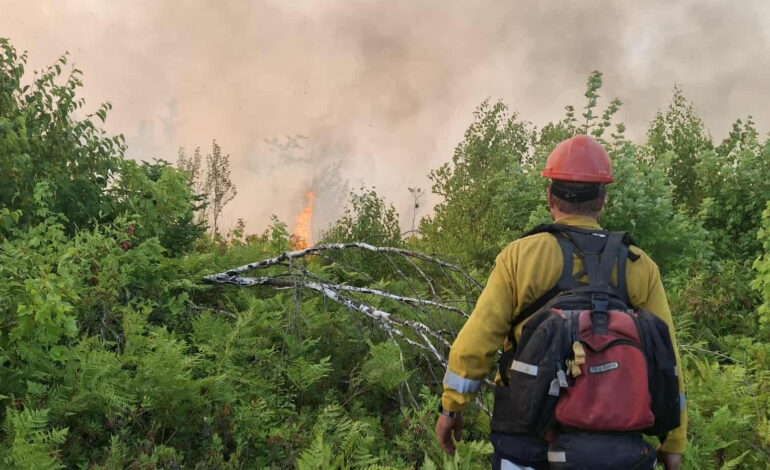


For Saint Andrews Fire Chief Kevin Theriault wildfire seasons in New Brunswick have always ebbed and flowed.
He has been wearing the fire chief’s white helmet for 14 years now. In May 2023, Theriault battled, alongside many other firefighters, a more than 500-hectare fire in Bocabec, known to locals as the Stein Lake fire.
It did claim one structure, but crews went door-to-door to evacuate residents in the mostly rural region of Charlotte County, executing a plan to keep locals safe.
“In the last few years, we’ve seen an uptick in how many forest fires around, but it goes in cycles,” he said in an interview with The Courier. “We’re in a dry year this year and hopefully things work out.”
Theriault said winter storms are also worse, causing trees and debris to accumulate in the forest, which is fuel for any forest fire that ignites.
“We try to get as much equipment on it as quickly as possible,” Theriault explained. “[We] get the [Department of Natural Resources] in almost immediately so we can escalate if we have to.”
The Department of Natural Resources (DNR) has not observed a drying situation as severe as this since 1986. Natural Resources Minister John Herron has repeatedly called the situation unprecedented.
Lessons from Stein Lake
The Stein Lake fire was one of the biggest fires New Brunswick had seen over the last decade – now surpassed by the Old Field Road fire in Miramichi.
An after-action report was commissioned following the fire. It also allowed the Department of Natural Resources and Energy Development to take a critical look at the way in which it responds to these environmental disasters.
Read more: Communication during Bocabec wildfire ‘challenging’: report
“In retrospect, Regional Emergency Operations Centre (REOC) should have been activated and equipped with the essential personnel to enable the better coordination of reports and situational awareness,” the report said.
It also spoke to confusion around the evacuation of local residents.
It said the timeliness and accuracy of the information being shared between the Provincial Emergency Operations Centre and the department, agencies and other organizations “varied” at times.
“Clear lines of communications, standardized formats for reports and returns, and time limitations for briefing should be developed and implemented to enhance communications,” the report said.
The department also did not issue an Alert Ready, according to an investigation by The Courier.
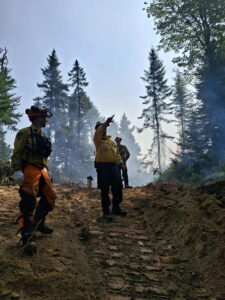
All that information is now being used to guide the response of the two out-of-control fires raging through New Brunswick.
Herron said it is using all the lessons learned – 12 recommendations in total – as the guideline.
“The recommendations of that report are what [is] guiding our actions right now,” he said. “We clearly have a more responsive, more iterative, with respect to notification than we would have had in that moment.”
The government said when and if the Alert Ready is required – it will be used.
Is this the new norm?
Anthony Taylor is an associate professor of forestry and environmental management at the University of New Brunswick.
“In the time period for which we have good data, and we’ve been monitoring these things closely, yes, this is the most severe drying that we’ve experienced in New Brunswick at least since the 1980s,” he said in an interview with The Courier.
Taylor, alongside many of his colleagues, have been predicting these conditions for quite some time – tied explicitly to climate change.
Read more: Eastern Charlotte issues water conservation order
“This is obviously an instance of climate change having an impact on extreme temperatures, lack of precipitation and when you have those things combined you end up with severe drought events like we’re currently experiencing in New Brunswick,” he said.
Taylor wrote a research paper on the Evolving role of wildfire in the Maritimes region of eastern Canada, which explains how only a marginal increase in precipitation will be insufficient to deal with the large projected increase in mean annual temperature of 2.0–6.0 °C – impacting relative humidity and soil moisture.
“The climate for the Maritimes is projected to be warm, it has already warmed several degrees above the 20th century average, so it is already warm,” he said. “It is projected to warm more.”
He said it means a higher probability of events like these throughout the Maritimes and New Brunswick.
“We haven’t had any rain in New Brunswick over the past 15 to 20 days and even June and July were below average in terms of precipitation, so you combine that with the warm temperatures … then you have a recipe for drought, warming and drying of fuels in the forest.”
The report said this link to warming and climate change will no doubt lead to more frequent and severe drought events, higher winds, and perhaps increased lightning, which will increase ignitions and make fires increasingly difficult to control.
Taylor said about 99 per cent of wildland fires are caused by humans. All three major fires in 2023 in Shelburn County, Upper Tantallon, Nova Scotia and Stein Lake, New Brunswick were suspected human-caused ignitions.
“I think the most important thing is … tackling climate change, pressuring our politicians to take climate change more seriously is single-handedly the most important thing going forward.”
Some forestry practices, he said, could also be changed to include more diversity in the type of trees planted by industry.
“Hardwoods tend to be less vulnerable than softwood,” he said. “So, maintaining species diversity, from a management perspective, would be important.”
Taylor urges people to be fire smart – and thinks putting a ban on activities during increasingly dry conditions is appropriate to prevent future fires.
“That will help them prevent those human-caused forest fires,” he said.