



Staff from the Town of Saint Andrews claim they were pressured by the Regional Development Corporation (RDC) to progress with the Market Wharf and Market Square refurbishment project despite the department approving a deadline extension application from the town well into 2027.
New documents obtained by The Courier through a Right to Information and Protection of Privacy Act application reveal the town received this deadline extension several months before asserting there was no flexibility.
“However, as requested, we can extend the end date to March 31, 2027, to provide the municipality with sufficient time to address these costs,” said an email from Kingsley Daniels to Chris Spear.
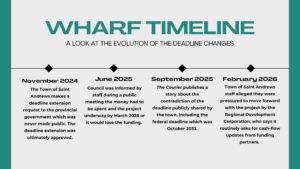
The Courier identified a discrepancy between two dates: the publicly-shared March 2026 deadline by the town, and the extended March 2027 deadline approved in November 2024. That extended deadline was later confirmed by Infrastructure Canada and the New Brunswick Regional Development Corporation. The latter deadline was not made public until this newspaper reported it, despite the request for an extension occurring seven months before town officials publicly asserted the earlier deadline.
“A staff member of RDC was pressuring us to identify the years of spending, as they needed to identify with Infrastructure Canada [which] fiscal years funding would be made available to the province,” Chief Administrative Officer Chris Spear said in response to questions from The Courier about the deadline extension application. “The province gets a pool of funding for multiple projects on an annual basis. From what I understand, those funds did not roll over. Our earlier applications had been spent in certain years prior to even 2025.”
Spear alleged RDC had indicated to him that the department wanted to allot funding to other projects.

“It was my understanding [that] the 2027 deadline was the last year of the national program, not just our project, as originally indicated in our correspondence with them from Feb. 27, 2021,” Spear said in response to questions from The Courier. “Letters from 2024 that officially allowed the scope change showed our funding still within that window.”
“Nor was it (the extended federal deadline) informally mentioned to me in various meetings with the funding partner,” he said. “So I continued to interpret that we needed to stay within the timeline of 2027 to maintain our funding.”
Spear wrote to RDC on Nov. 12, suggesting the town could move to an option that would reduce the amount of infill because of the environmental impacts. The work required remediation by the federal Department of Fisheries and Oceans. He said in the letter that reducing the infill would increase the cost, prompting him to request additional funding.
“The Regional Development Corporation routinely asks funding recipients, including the Town of Saint Andrews, for cash-flow updates as part of the financial management of our funding programs.”
“An alternative solution is to remove most of the infill out of the scope of the project, and that would be deemed staying within our own footprint, and we can proceed. However, there is a significant extra cost related to that option as the fill was meant to reduce the expense of adding piles and [reinforced] concrete decking,” he said in the letter to RDC.
Spear said a second scope change after the public feedback could take months because it would need to be reviewed by Infrastructure Canada.
“In my eyes, the window was shutting down to complete the project, even if we were allowed to extend it a few months to the end of 2027,” he said.

Spear said he’d warned council that, given the increase in construction costs since the COVID-19 pandemic, the project would likely come in over budget.
“The longer the council and the community took to make a decision, the higher the costs were going to go,” he said. “I expect all councils — this and future — will need to address the wharf upkeep in phases, reduce the scope, and hope there is more funding from other levels of government for this in the next five to 10 years. Otherwise, there’s a risk the taxpayers and users will have to assume all of the costs related to issues not addressed under this program. This is a major consideration.”
The town was balancing two competing pressures, he explained: the province’s expectations around funding allocation and the need to reduce the impact on the tourism season.
Read more: Feds, province contradict town on wharf, square timeline
Seasonal businesses, including whale watching operators, which make the majority of their revenue during tourism season, were also concerned about the timeline.
“The fiscal year for [the Government of New Brunswick] is March 31. They did approve until that date,” Spear said. “In order for the project to meet that deadline and not interfere with the 2026 [tourism] season, we needed to start the project over the winter of 2025/2026. The original plan was to remove a large section of the wharf that made it inaccessible for several months. If we waited until spring 2026 to start (or later), it would have extended well into summer and likely fall.”
RDC did not directly respond to the town’s claims, nor did it indicate whether other projects may have been identified that could use the money already allocated to the town.
“The Regional Development Corporation routinely asks funding recipients, including the Town of Saint Andrews, for cash-flow updates as part of the financial management of our funding programs,” the department said in an emailed statement.
Extension timeline
On Nov. 12, 2024, Spear wrote a letter to RDC requesting an extension for funding for the town wharf. The letter, obtained by The Courier, asked to extend the wharf funding deadline to March 2027 and requested an additional $1 million for the project.
“Consequently, the additional investment could be $1.5 million to $2.0 million. We have requests for your consideration. Can we extend the funding deadline to March 2027? We would like to be considered for an additional $1.0 million in funding towards the project,” he wrote in the letter.
Six days later, the department emailed Spear to say the additional funding could not be provided because “the funding for the program had been fully dispersed.”
That meant RDC could not provide more funding, but an extension was granted.
In June 2025 council was informed by former clerk Paul Nopper that the grant money needed to be spent and the project underway by March 2026. With that information, several councillors publicly said they felt they needed to push ahead with the project despite strong community feedback.
“We can continue doing the project if it is in place and moving forward past the March 2026 deadline, because we’re showing we’re finishing the project,” Paul Nopper said at the time. “But basically, we’ve been told, March 2026; if you haven’t done anything, you lose the funding.”
Nopper told The Courier that staff had “noted to council previously all deadlines [associated] with the funding and that we would be seeking an extension based on the need for additional review, consultation, project oversight, and timelines.”
Nopper publicly stated a deadline of March 2026. He confirmed staff were in constant contact with RDC.
“Items discussed included deadlines for funding to be spent, funding extensions, fund submissions to date, project updates, and next steps,” Nopper said in a statement.
The rehabilitation of Market Wharf and Market Square is being funded through the federal Department of Housing, Infrastructure, and Communities Canada (HICC). Federal funding is distributed to the provinces and territories through bilateral agreements. In New Brunswick, the RDC administers those funds.
The bilateral agreement signed by New Brunswick and the federal government indicates a program to end in October 2033.
“For projects funded under the public transit stream, the green infrastructure stream, the community, culture and recreation infrastructure stream, and the rural and northern communities infrastructure stream, New Brunswick will ensure that all Projects are Substantially Completed by October 31st, 2033,” the agreement said.
“The Canada-New Brunswick Integrated Bilateral Agreement for the Investing in Canada Infrastructure Program (ICIP) requires that all ICIP projects in the province be substantially completed by Oct. 31, 2033, and that all final expenditure claims be submitted by Dec. 31, 2033, said a statement from HICC to The Courier back in September 2025.
“We can confirm that Housing, Infrastructure, and Communities Canada has not imposed any deadline on the projects in Saint Andrews, other than the 2033 dates mentioned in the Bilateral Agreement.”
In a June 2025 statement, RDC also told The Courier that the provincial deadline could be extended, provided the town gave the department a timely and justifiable reason and a revised timeline.
The project, a hybrid infill design, faced public pushback in the months leading up to the tendering process.
Engineer renderings showed the design expanding the footprint of Market Square and infilling about 40-50 metres from the shoreline using armour stone. The work was intended largely to mitigate future impacts of climate change, but also to repair the inner approach, which is under a weight restriction.
The new design differed slightly from the original renderings and ultimately caused a rift between supporters and opponents.
Project on provincial radar
The project has come up in two separate fiscal updates by the provincial Liberal government, which is now projecting a record $1.33-billion deficit.
Finance and Treasury Board (FTB) Assistant Deputy Minister Nick McCann said in November 2025, there were several delayed projects impacting both sides of the budget.
The Rothesay wastewater project, the Saint Andrews Market Wharf and Market Square project, the Mount Allison University library rehabilitation, and the UNB Law building are all part of the Integrated Bilateral Agreement, which includes about $88 million in federal funding.
In September 2025, the Market Wharf and Market Square project budget came in about $2 million over budget. That cost, along with strong community criticism of the design, sent the town back to square one.
“Given the amount of economic uncertainty and cost escalations we’ve seen in recent years, those types of projects have caused some delays … looking at their scoping, their timing, because of the cost escalations. There’s only a finite amount of money they’ve received for their project and for their funding,” said McCann. “If it comes in higher than that, sometimes the proponent may need to adjust and then go back to the drawing board, adjust their plans, and then come back forward again.”
Once again, just weeks ago, The Courier spoke with FTB regarding the funding for those projects.
The Special Operating Agency (SOA) continues to impact both the revenue and expense sides of the provincial budget, according to FTB. On the revenue side, the SOA is down $11.9 million, while on the expense side, it is under budget by $61 million.
Finance Minister Rene Legacy also said the province would not be in a position to help proponents, such as municipalities, cover “federal shortfalls”. The province is set to bring forth its budget on March 17.
The Liberal government has been warning of difficult decisions amid the growing deficit and has turned to the public for feedback on where cuts could be made.
Saint Andrews town council has received a structural report from Fundy Engineering showing major areas of concern that should be addressed within the next year, including the head of the wharf and the inner approach.