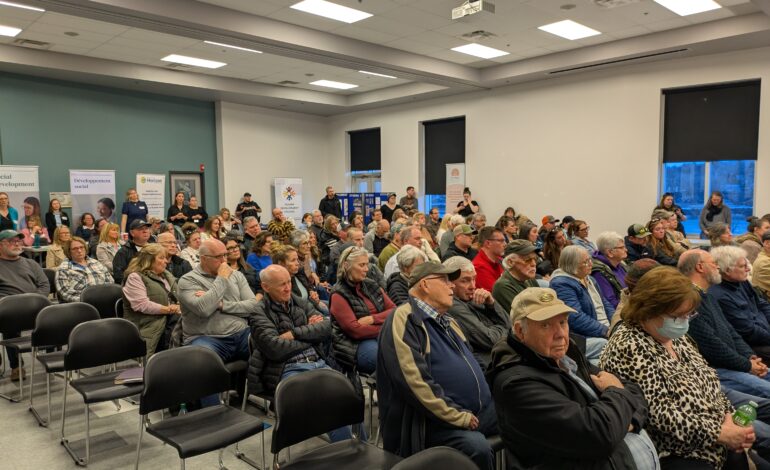


There are many ways to measure the quality of a place. Some people look at property values, school rankings, or the price of a decent latte. I look at how dogs get on.
By that measure, Saint Andrews is one of the finest places on earth.
Our love of dogs is immediately apparent to even first-time visitors. Stay at the Algonquin Resort and you will be greeted by Leia, the historic hotel’s famous lobby dog. While her human co-workers help guests check in, Leia welcomes visitors by offering an ear for scratching or rolling over on her dog bed for a belly rub. Her relaxed state tells visiting canines that dogs, too, are meant to enjoy their time here.
Downtown on Water Street, a dog cannot so much as glance toward a storefront without being rewarded for it. Accompanying their humans while they run errands is not a chore for the local canine population but a kind of tasting tour, a carefully paced downtown sampling circuit. The local economy may technically run on tourism and small business, but it is equally sustained by dog biscuits and puppy-dog eyes.
At the post office, dogs wait with the quiet dignity of someone expecting important correspondence. The postmaster delivers each biscuit like registered mail—priority, hand-stamped, handled with care.
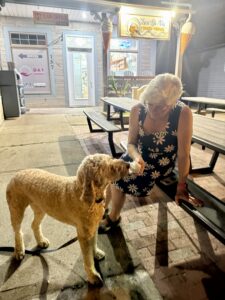
At Cockburn’s Drugstore, there is no need for such formality. The treat appears the moment Maud crosses the threshold, as if conjured. It is understood that she is here on official business, and that business is being a good girl.
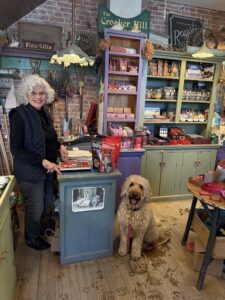
Around town, she has her stops: The Crocker Hill Store, Buoy Up!, Cummings Convenience, LH Boutique, where the treats are selected with the seriousness of a wine pairing. Over time, a dog begins to understand the geography of generosity. They learn the route. They remember who carries what. They develop relationships.
And that’s the thing about a small town. You don’t just have places you go. You have places where you are known, whether you have two legs or four.
By the time we complete a loop of town, Maud has effectively enjoyed the canine equivalent of a full Costco sampling circuit, only without the existential dread of spending $300 on things you didn’t know you needed.
Then there are the days that go above and beyond.
When we order from King Street Pizza, Maud stations herself by the door long before the car arrives, alerted by some internal radar system. Caroline appears not just with pizza for us, but with what can only be described as Maud’s personal charcuterie: slices of ham, presented immediately, no waiting, no sharing, no questions asked. It is, frankly, Michelin level service.
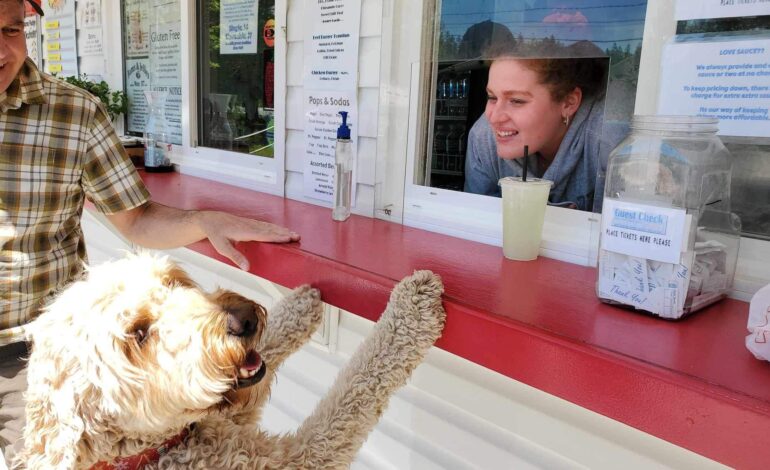
In the summer, Sea La Vie hands out pup cups, tiny servings of soft ice cream that transform an already good day into something cinematic: a dog eating ice cream by the sea, living a life most people would envy and few dogs fully appreciate.
And then there is the local Tim Hortons. If you think all Tim Hortons are the same, then you’ve never been to St. Andrews.
The drive-thru means only one thing to Maud: a plain Timbit. She begins her ascent from the backseat like a mountaineer, climbing over my husband Patrick as though he were simply part of the terrain. By the time we reach the window, she has wedged herself into the driver’s seat, head out, eyes bright, nose working overtime.
She drools. Profusely.
It drips onto Patrick—his coat, his arm, his dignity.
“Oh, Maud,” he says every time, in the same tone of mild betrayal.
And every time, we do nothing to stop her. Because this absurd, slightly chaotic, deeply joyful ritual is part of the point.
Maud loves the Timbit, yes. But more than that, she loves the recognition. The way the person at the window lights up and says her name like they’ve been waiting all day to see her. The way she is not just a dog at a drive-thru window, but a regular. A customer. Someone expected.
We learned just how unusual this was years ago when we took Maud to the city and she attempted, with great confidence, to insert herself through the drive-thru window of a Saint John A&W. She was not met with the usual enthusiasm she generates back home. Instead, Maud’s theatrics incited genuine terror from a poor employee who was absolutely not prepared to be greeted by a large, enthusiastic dog trying to order her own meal.
It was a humbling moment for Maud.
But an educational one for us.
Because that’s when you realize that what feels normal in a small town is not normal everywhere. Not everywhere is a place where people know your dog, where they keep treats behind the counter just in case, where a quick errand quietly turns into a series of small, friendly encounters.
A dog measures a place very simply: Who is happy to see me? Where do I get my cookie? Where does everyone know my name?
By those measures, Maud thinks there’s no place like home.
And honestly, she’s right.