


By Brian Owens, Reporter
The Municipal District of St. Stephen (MDSS) and the provincial government say while they are committed to eliminating the need for a homeless shelter in the community, it cannot move forward without a location for transition housing.
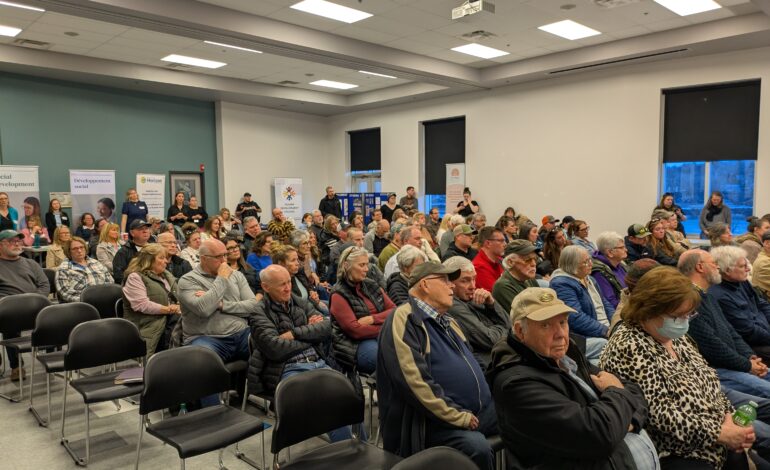
Around 150 people gathered at the Garcelon Civic Centre in St. Stephen on March 24 for a panel discussion and question and answer session with MDSS Mayor Allan MacEachern, Social Development Minister Cindy Miles, and Housing Minister David Hickey.
There was also a trade show of local organizations that provide programs and support in the area, including Neighbourhood Works Inc. (NWI), Horizon Health Network’s (HHN) addictions and mental health unit, the Department of Social Development, the RCMP, the Sophia Recovery Centre and the Human Development Council (HDC).
Jim Stuart, executive director of NWI, which operates the shelter, told The Courier that the goal of the event was to provide the public with information and facts about homelessness in the community, and a better understanding of the provincial and municipal governments’ plans.
“It’s clear what our plan has been, the next step is housing. We want to eliminate the need for a shelter,” he said. “We’ve put in the work and are still hopeful [it will happen].”
The organization’s most recent proposal for transitional housing units at 199 Union St. was rejected by council in January.
St. Croix Progressive Conservative MLA Kathy Bochus said she hoped the provincial ministers would be able to answer the community’s questions about future plans.
“There has been so much unease about where a shelter or bridge housing will go,” she said. “I don’t have the answer, I’m hoping to hear that tonight.”
No new project
There was never any plan to announce a new project at this event, but the panel reiterated that both town and province are committed to finding a solution that works for the whole community.
“We know the shelter is not sustainable, and not the right solution for St. Stephen,” said Hickey. “We need to respond to the concerns in a way that offers both long and short-term solutions for people and the community.”
There are projects in the works that can contribute to the solution. The province recently expanded the number of beds available at Ridgewood Addiction Services in Saint John, and a new 50-bed rehab centre on the Kingston Peninsula is set to open this summer.
Hickey also highlighted the $300 million deal the province recently signed with the federal government to build 1,200 affordable homes over the next two years, including some bridge and transitional housing units.
MacEachern said the new apartment complex being built on the site of the old Border Arena will help to alleviate some of the pressure on the rental market.
“That’s a preventative measure,” he said.
But Miles said the first step towards a permanent solution is to choose a location for supportive housing.
“We need a space, that’s the biggest obstacle to bridge housing,” she said.
Sharing success
Staff from NWI shared success stories from those they have helped in recent years, by getting them into stable housing, helping set up bank accounts and government ID, and providing ongoing support as they deal with addiction.
Over the past four years the organization has helped 67 people find and maintain housing, and 25 enter detox and recovery.
“That’s what success looks like,” said Stuart.
Stuart and the panel also addressed some of the misconceptions surrounding homelessness. Hickey rejected the idea that providing services in St. Stephen would lead people to move here from elsewhere in the province.
“If that were the case, everyone would go to Saint John,” which has better services and more options for bridge housing, he said. “It’s not going to be a magnet.”
Jay Coates, who works with at-risk youth through NWI, noted that 90 per cent of the people who use the shelter in St. Stephen have Charlotte County family names.
The idea that most homelessness is caused by addictions is also false, said Cory Herc from the Human Development Council, a Saint John-based nonprofit that provides data-driven solutions for homelessness.
“It’s almost always about housing affordability and availability,” he said, both of which have worsened in recent years. “Most other issues are consequences, not causes.”
Just 25 per cent of those who become homeless do so because of addictions, Stuart said. But after a year, around 90 per cent will have developed addictions as a way of dealing with the stress of homelessness.
The housing first strategy being pursued by NWIand the province, in which housing is not conditional on sobriety or abstinence, has seen great success where it is implemented, Stuart said. The largest study on the topic, which was conducted across Canada, found that over 80 per cent of those who received housing first remained housed after the first year, compared with just 31 per cent who received traditional interventions.
A receptive audience
The response from the audience was largely positive, with applause for success stories, and thoughtful questions for the panel. Many said they left with a better understanding of the plans, and hope that solutions will come soon.
“It was good to hear that the government is still committed to bridge housing, to transitional supportive housing in St. Stephen,” Walter Thiessen said. “It’s been pretty frustrating to have the process of developing that housing take as long as it has. I hope the community can become more unified in supporting this and accepting a place for it.”
But many said they also left with important questions unanswered.
“They didn’t seem to answer a lot of questions that people have,”Rob Watson said. “They talked a lot about what they accomplished so far, but not a lot about the future.”
Chris Gorman from OrgCode Consulting, who facilitated the event, was pleased with the level of community engagement.
“Showing up matters,” he told the crowd. “Things don’t get better if no one shows up.”
“This is our issue,” said MacEachern. “We need the province to help, but we can’t walk away from it.”