


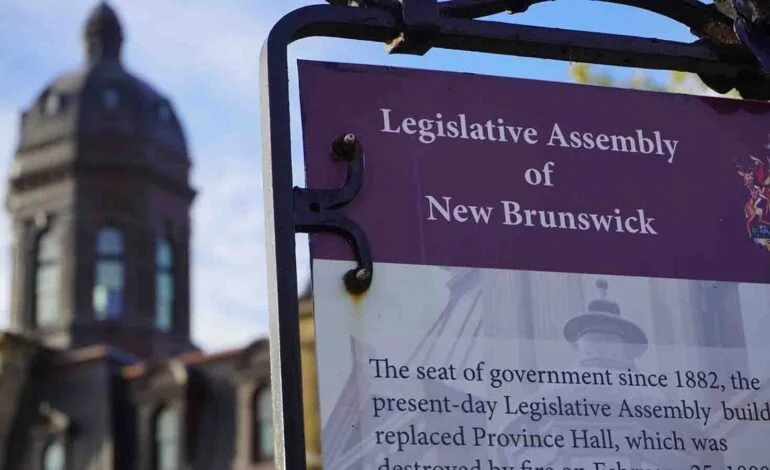
The provincial government says the projected deficit is expected to hit $1.66 billion, ballooning again from earlier predictions of $1.39 billion.
According to the Department of Finance and Treasury Board (FTB), revenues were down $35.8 million. The department said this is largely due to lower federal conditional grants under the integrated bilateral agreement.
The Department of Health (DOH) is projected to be over budget by $108.1 million, according to Nick McCann, the assistant deputy minister for FTB.
Similarly, Social Development is projected to increase by $123.2 million due to increased demand for income security, child welfare and youth services and disability support.
Health is higher than anticipated, McCann said, largely due to operational costs within the regional health authorities (RHAs).
Other departments are also over budget including, Transportation and Infrastructure, Justice and Public Safety and the New Brunswick Housing Corporation.
Only two departments were under budget: the Department of Education and Early Childhood Development by $15.8 million due to under expenditures related to the Canada-New Brunswick Early Learning and Childhood Agreement, and the Opportunities New Brunswick by $5.6 million due lower projected financial assistance.
McCann said this is due to childcare spaces not being filled as quickly as anticipated.
“No specific reason given by the department,” he said. “It’s still a priority for the department and they do plan to open those spaces, albeit it’s just at a slower rate than we thought we would have.”
Recently, Eastern Charlotte approved a construction tender for a childcare facility in St. George, which would create 82 childcare spaces.
The municipality was placed under a deadline of June 30 to approve a financial plan after several extensions on the spaces allotted to them through the provincial-federal agreement.
Reduction in civil service
Despite the continued growing deficit and spending, Finance Minister Rene Legacy said the government is looking at “all of the possible avenues.”
Legacy reiterated programs and policies that have been put in place to reduce cost to constituents, including the rent cap, a 10 per cent rebate on utility bills and school breakfast programs.
He said the government is also exploring other opportunities to grow the economy, citing a decision to review the moratorium on hydraulic fracturing for natural gas.
The province said it would be looking to make cuts to reduce the deficit.
Legacy said 204 positions have been eliminated from the civil service through attrition — a reduction of staff through resignations, retirements or death — and the government is on target to hit 259 by the end of the year.
“To date, we have identified approximately $75 million in efficiencies,” he said.
He said it isn’t easy to make financial cuts to departments like Social Development and health care with increasing needs. Legacy said 1,300 households were added to the number of those needing social assistance — or about 1,800 individuals.
“How do we decide who gets help and who does not,” he said. “We have to provide that help.”
Global uncertainty
The United States has imposed 50 per cent tariffs on $27.6 billion worth of Canadian goods.
“We didn’t ask for these tariffs, but alone they have the ability to impact 500 jobs here in New Brunswick,” Legacy said. “This certainly increases the uncertainty of the economic climate that we work in.”
Assistant Deputy Minister Todd Selby said the province is equally worried about what could happen to its internal trading partners.
“A lot of this is targeted toward Ontario and Quebec,” he said. “They buy a lot of New Brunswick products, so you have to think about that as well.”
The minister said of all the factors impacting the economy, population decline is at the top of the list.
In New Brunswick, the population has declined for three straight quarters.
“I would say a sustained growth in our population is going to be necessary to continue to allow us to do what we want to do as a province,” he said.
Progressive Conservative interim leader Glen Savoie said the Holt government continues to spend recklessly without results.
“The most concerning thing is what this will mean to our credit rating,” he said in a statement. “A higher cost of borrowing means less money available to pay for the services New Brunswickers need every day.”
He said the government’s spending is unsustainable now.
“The Holt government does not even know where they are spending our money,” he said. “Which programs are delivering results intended? Which are not? Start there.”
The minister said several departments are undergoing financial auditing and monitoring to determine how to lower their expenses.
He said the province recognizes the longer it takes to implement savings, the greater risk there is to the financial outlook.
“For that reason, we will continue to act with urgency, discipline and care,” he said.