


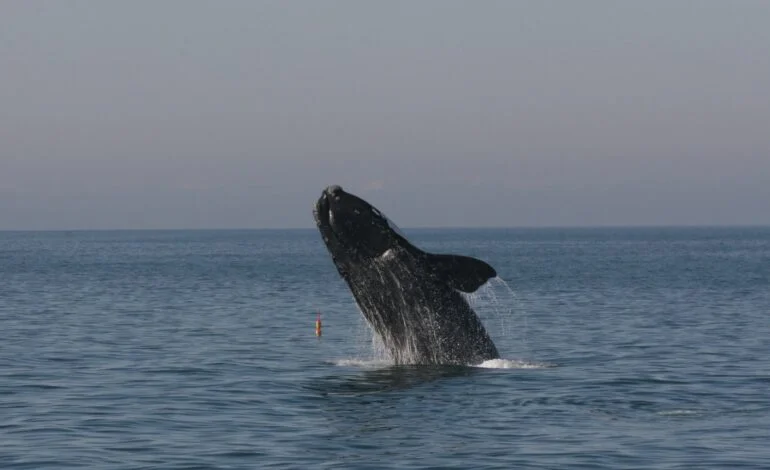
North Atlantic right whales, which spend much of the summer in the oceans off Canada’s East coast, are the most endangered whales in the world — with a surviving population of less than 400.
Several conservation measures have been put in place to help protect them from the human activities like fishing and shipping that threaten them, including vessel exclusion zones and ship speed limits in the places where they feed, and fishing restrictions when they are spotted in an area. But new research by ecologist Jay Kirkham from Dalhousie University in Halifax has revealed new information about their feeding patterns that may put them at higher risk of ship strikes than we thought.
Kirkham and his colleagues used suction cups to attach tracking devices featuring video cameras and an array of other sensors such as accelerometers, gyroscopes and depth recorders to 23 right whales in the Gulf of St. Lawrence. The sensors allowed them to determine the body position, movement and behaviour of the whales as they swam.
“Even though whales aren’t always the best camera operators, we were able to analyze enough video to train machine learning algorithms how to identify periods of feeding,” said Kirkham.
The data, published in the journal PLOS One, shows that the whales spend on average 11.4 hours feeding every day, and their feeding behaviour changes over the course of the day as they follow their tiny plankton prey. During the daytime they feed close to the seafloor, but at night they forage much closer to the surface, something that had never been observed by scientists before and so was not taken into account when designing protection measures.
“I think the most interesting thing that we found is that the whales switch their feeding behaviour at night, feeding much closer to the ocean’s surface, which could put them at a higher risk of collision with boats during the night,” said Kirkham. The whales also spent about 25 per cent of their time feeding outside the vessel exclusion zone, another way they could be at higher risk of collisions.
Kirkham hopes his work will help with the development of new conservation strategies that could better protect the whales. “Being able to study one of the most endangered whales in the world is an amazing opportunity,” he said. “We hope that by understanding more about the right whale we are able to contribute to their survival.”
 Brian Owens has been working as a journalist focused on science and the environment for 20 years, both in the UK and Canada. He moved to St Stephen in 2012.