


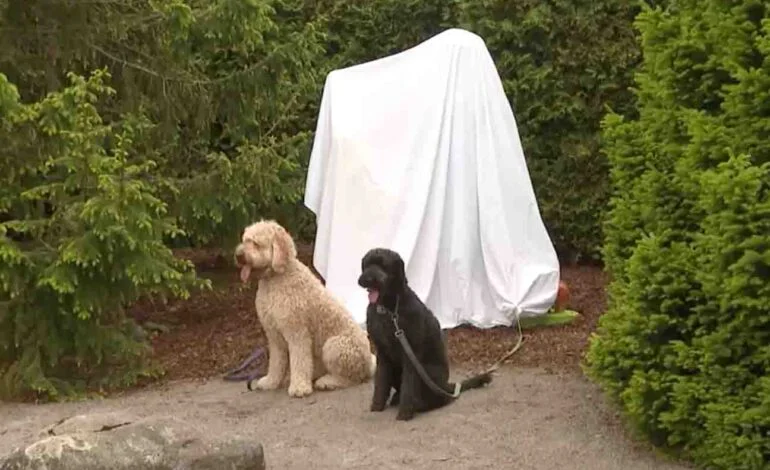
Not long after Queen Elizabeth II died, Maud was invited to unveil a statue in her honour at Kingsbrae Garden. This was, to my knowledge, Maud’s first royal engagement.
Mrs. Lucinda Flemer had commissioned the sculpture out of a deep admiration for the Queen and the way she had carried herself through 70 years on the throne: with a steady hand, empathy, grace and an unwavering sense of duty.
In her own way, Mrs. Flemer has spent a lifetime quietly leaving her mark on St. Andrews, rarely calling attention to how much of it bears her fingerprints. There are people you meet who make you think differently about what can be done with a life. I always stand a little straighter around Mrs. Flemer.
Which was unfortunate, because on this particular day I had Maud with me.
The plan for the unveiling involved two dogs, one large sheet and a considerable amount of faith. The sheet covering the new sculpture would be tied at either end to the collars of Mrs. Flemer’s black Standard Poodle, Jasper, and Maud. On cue, they would run forward together, the sheet would fall away and the Queen would be revealed. It was a perfectly reasonable plan if you had two Jaspers.
We had one. We also had an audience and TV news cameras rolling for the official unveiling.
Jasper was a few years older than Maud, already a dog about town and the unofficial mascot of Kingsbrae Garden. He was elegant, composed and knew how to conduct himself in public.
Maud was four and still required a daily regimen of Frisbee catches, leashless beach runs and long walks around town just to bring her down to normal household voltage.
I had never taken her to Kingsbrae before, for this very reason. When Maud entered unfamiliar territory, every tree, shrub, bench and suspiciously interesting patch of dirt first had to pass an aggressive visual inspection and sniff test.
Now her first visit would involve being physically attached to another dog while unveiling an important piece of public art dedicated to the Queen in one of Canada’s most celebrated gardens. I wasn’t entirely confident she would execute her duties flawlessly.
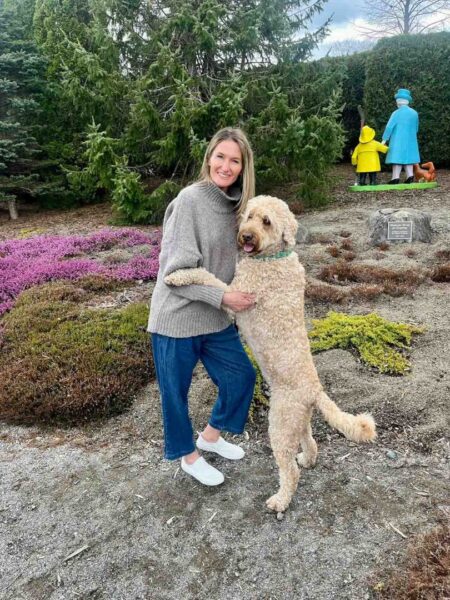
But there are invitations you don’t turn down. And something about two dogs being chosen for this particular job touched my heart.
Dogs had followed Queen Elizabeth through nearly every chapter of her life. She was given Susan, her first corgi of her own, for her 18th birthday in 1944, shortly before the end of the Second World War. Susan later accompanied Princess Elizabeth and Prince Philip on their honeymoon. Over the decades, the Queen would own more than 30 corgis and dorgis, many descended from Susan.
Think about the span of history those little legs trotted through.
The war ended. Prime ministers came and went. Britain and the Commonwealth changed. Elizabeth went from princess to young Queen to grandmother and great-grandmother, eventually becoming the longest-reigning monarch in British history. And somewhere in the private spaces between all that history, there were dogs.
One of the three official portraits released for the Queen’s 90th birthday showed her not with a crown or sceptre, but outside at Windsor Castle with four of them: Willow, Holly, Vulcan and Candy.
Mrs. Flemer, a dog lover herself, innately understood that a dog also belonged in Kingsbrae Garden’s statue. When she commissioned sculptor Domenico Di Guglielmo to create Memorial to the Queen, she wanted to capture something of the woman as well as the monarch. The Queen is cast in motion, walking along a path, Paddington-inspired bear holding one hand, her face turned toward whatever lies ahead. And keeping pace at her side is a corgi.
Of all the symbols that could accompany a Queen into perpetuity — crown, throne, sceptre, the grandeur of a 70-year reign — there is her dog. And now Jasper and Maud were going to unveil the masterpiece.
We positioned them the way proud dog parents arrange their children for a portrait: straighten this one, move that one slightly, say “stay,” then back away cautiously while continuing to say “stay,” as though introducing any variation in vocabulary that might collapse the entire operation.
Miraculously, they stayed. To an unknowing eye, they looked like two members of the Queen’s Guard standing at attention. Jasper genuinely looked regal. Maud, too, looked regal if you didn’t know Maud. I did.
She was perfectly still, but every muscle was engaged. She looked less like a royal guard than a racehorse waiting for the gate to open. The countdown began: Three… Two… One!
Maud took off like she’d just robbed a bank. Jasper, unfortunately, was attached to the other end. Seconds earlier, he had been a member of the Queen’s Guard. Now a Goldendoodle was attempting to turn a royal unveiling into a getaway heist.
But Jasper found his footing. He didn’t panic or try to match Maud’s chaos. He steadied himself and kept going, and somehow Maud fell into step with him. The sheet came away. The Queen appeared. The monarchy survived. Maud had completed her first royal engagement with considerably more velocity than protocol probably required.
Watching Jasper quietly steady her, I couldn’t help thinking how appropriate it was. Mrs. Flemer had created a tribute to someone she admired for her steadiness, and here was Jasper doing what good companions often do: adjusting his pace for the one beside him.
Maybe that’s part of what dogs have always been to us.
The Queen’s corgis couldn’t possibly have understood that the woman scratching behind their ears had been Queen longer than most people had been alive. They didn’t know her face appeared on money across the Commonwealth. They didn’t know prime ministers sought her counsel. She was simply Mum.
And I suspect Maud operates under a similar understanding of me. Whatever I bring to the table by human standards is largely irrelevant. I’m her person. That’s the whole résumé. Maybe that’s why Mrs. Flemer’s tribute has stayed with me.
Even a woman whose life became inseparable from history had a private life made up of the same attachments the rest of us understand. Her dogs were there across the decades, in photographs and on country walks, in the ordinary spaces between extraordinary obligations. The Royal Family’s own account of her life notes the simple pleasure she took in walking in the countryside and spending time with them.
They couldn’t stop time. They couldn’t know where the path was leading. They just walked it with her..
Here is a woman who belonged, in some sense, to history. But beside her is the little creature to whom she simply belonged.
And they’re still walking together.