

When my mother announced that she was getting a dog, I remember thinking it was an odd choice. Not a bad one. Just… unexpected. The truth is, she hadn’t planned it either.
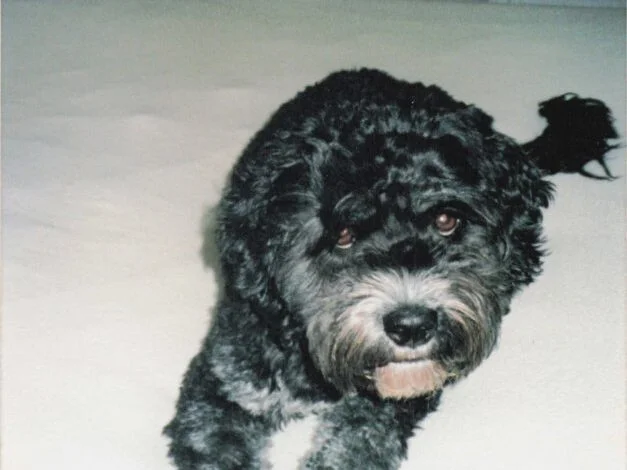
A friend of hers from Montreal was driving home from Newfoundland after delivering a horse when he spotted what he thought was a bear cub on the side of the road. When he stopped, he discovered a young dog—scruffy, matted and painfully thin—who appeared to have been surviving alone in the woods.
He couldn’t leave her there, so he brought her home. Unable to take in another rescue himself, he called my mother.
“You’re a Maritimer, and she’s from Newfoundland,” he told her. “You’re both East Coasters. She’s meant for you.”
That was apparently enough. Mom took her in and named her Annie, in honour of her orphan beginnings. We never learned how Annie ended up alone in the Newfoundland woods. Mom always said that would be one of the first things she asked when she got to heaven. She believed Annie had been placed in her path for a reason. At the time, I wasn’t so sure.
My brother and I were grown and living elsewhere, and Mom had a full life. I didn’t understand what a dog would add to it. But Annie did. She became Mom’s constant companion. She was serious and watchful, with the particular loyalty of a dog who seemed to understand exactly who had saved her.
I watched their relationship mostly from a distance. When I came home to visit, I wasn’t sure who Annie thought I was—a relative, perhaps, or an old family friend—but certainly not the daughter. She was the daughter.
Years later, I came home to St. Andrews under circumstances I hadn’t anticipated. I had been working in magazines in Montreal and Toronto when a beauty assignment involving hair extensions went spectacularly wrong. My scalp reacted, much of my hair fell out, and suddenly the person who had spent years writing about beauty was hiding what remained of hers under scarves and wigs.
I came home intending to stay for six months or so, long enough for my hair to grow back. Annie had other plans.
Until then, our relationship had been cordial but ill-defined. She was Mom’s dog and I was the person who appeared periodically with a suitcase. But now I was home every day, and Annie seemed to recognize an opening in her schedule. She needed walking. I needed somewhere to go. So we walked.
We walked to the wharf at night and along the familiar streets of my childhood. We watched the tide redraw the shoreline and the seasons change. Annie didn’t care about my hair, my career or when I planned to leave again. She cared whether I had remembered the treats. It was an excellent arrangement.
I talked to her on our walks. She listened without interrupting, advising or trying to solve anything, which already gave her an advantage over most humans. And somewhere along the way, the relationship changed. Annie stopped being my mother’s dog. She became my sister.
I began to understand what Mom had discovered years earlier. A dog’s companionship is strangely uncomplicated. Annie didn’t need to know what I was going to do with my life. She was interested in the life directly in front of us: a walk, an interesting smell, something moving in the bushes, the possibility that I might have food in my pocket. There was something enormously comforting about that.
Eventually my temporary return stopped being temporary. I met Patrick, found my way back into journalism–this time local journalism and not fashion magazines–and began building a life in New Brunswick. Annie was there for all of it.
By the time Annie reached 16, I had gone from wondering why my mother needed a dog to being unable to imagine our family without one. Mom said she would never get another dog. Annie had arrived through fate, and she couldn’t imagine deliberately trying to replace her.
I didn’t want to replace Annie either. But I wanted the next dog in our family to know her. It became oddly important to me that their lives overlap. I had the slightly irrational but very firm conviction that Annie had things she needed to teach the next dog—not tricks, exactly. More like institutional knowledge. And so Maud arrived.
Annie greeted this development with limited enthusiasm but considerable patience. She was older, dignified and accustomed to certain standards. Maud was a puppy. Still, Annie showed her the ropes. Most importantly, she apparently explained Mom’s garden to Maud on our morning visits to my parents’ house.
Years earlier, Annie had learned that Mom’s garden was sacred territory. She had received this information directly from Mom and apparently found the presentation persuasive. Maud has never gone into it. No one taught her this. There are probably rational explanations. I have no interest in hearing them. I prefer to believe Annie briefed her.
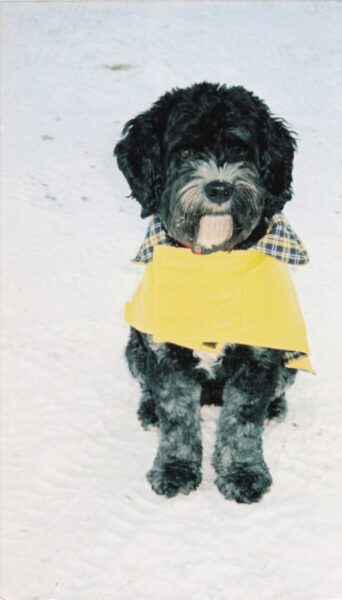
And maybe she told Maud other things, too. That Mom appreciates a loyal friend. That I will turn almost any outing into an adventure and require canine company. Where the treats are kept. Which family member is most likely to share food. When someone needs cheering up. The things you learn about a family after years of quietly observing it.
As Maud grew, Annie slowed down. Eventually Annie could no longer climb the stairs in my parents’ house. Mom put a mattress on the living-room floor and slept beside her. After all those years of Annie watching over Mom, Mom listened to Annie breathe through the night, making sure she felt safe for as long as possible.
When Annie died, Mom didn’t simply lose her dog. She lost a daughter. And I lost my sister.
But Annie had managed one last thing before she left. She had known Maud. That mattered to me more than I can reasonably explain.
Maud now visits her Granny nearly every morning. There is coffee for us, Frisbee for Maud and a photograph of Annie nearby. Maud is considerably more theatrical than Annie ever was, but there are things about her that feel familiar: the loyalty, the companionship, and the strange ability to know when someone needs her.
And, of course, the garden.
One day we will lose Maud too. That’s the terrible bargain hidden inside loving a dog: you welcome this creature completely into your family while knowing that, almost certainly, you will have to say goodbye.
Annie taught me that knowing how it ends isn’t a reason not to begin again. Perhaps that’s why I needed Annie and Maud’s lives to overlap.
Annie taught me that the answer isn’t to protect ourselves by loving them less. It is to leave the door open. Because sometimes another dog walks through it. And somehow, she already knows the rules.