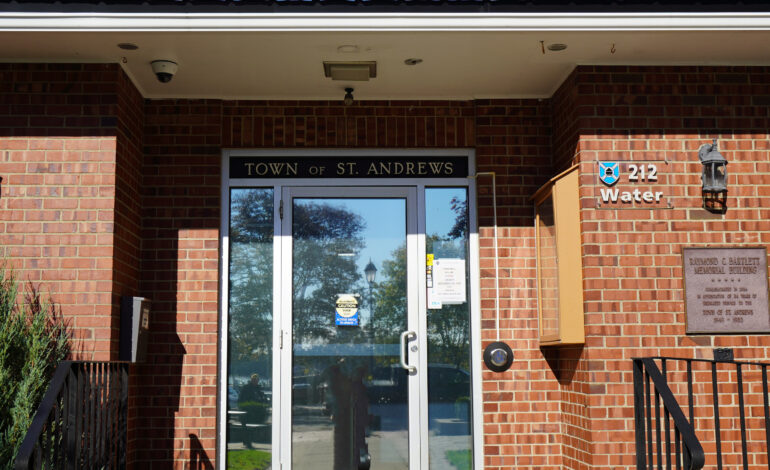


A three-person tribunal has dismissed an appeal by a Saint Andrews resident that dates back nearly two years.
Daniel Leger, Giselle Price and David Hildebrand sat through two hours of evidence and submissions by the appellant, Guy Groulx, and the respondent, the Town of Saint Andrews.
The appeal before the Assessment and Planning Appeal Tribunal was first heard in May 2024. The Court of King’s Bench sent the appeal back to square one following a review by a judge.
The tribunal’s main purpose is to hear appeals that deal with the misapplication of the assessment and planning process.
Unlike the courts, the burden of proof is on the balance of probabilities, not beyond a reasonable doubt. The onus is on the Town of Saint Andrews to prove there was no misapplication of the bylaw.
The planning decision
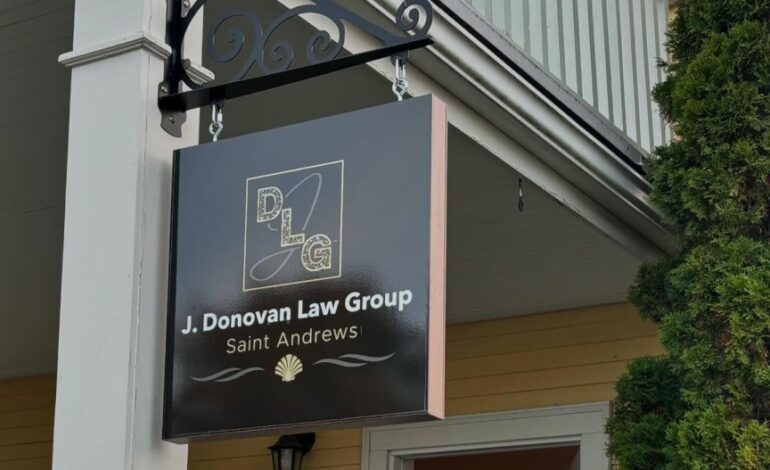
J. Donovan Law Group, which owns 298 Water Street, sought approval to operate a law office out of the property.
A request for terms and conditions the property was recommended by the town’s planning advisory committee (PAC) — a subcommittee of council that reviews zoning and variance applications — with the condition there be parking.
“Given the proposed office use barely rises above the category of home-based business, in staff’s opinion, the parking shall be made only as a term and condition imposed on the change of use,” the minutes of the May 2024 meeting said.
Home-based businesses are allowed in areas of mixed-use, but those have limitations, including being restricted to one employee who must live at the residence.
Jennifer Donovan, who owns the law firm, told the tribunal she doesn’t live there and at least one other employee uses that office space.
Alex Henderson, planning director for the Southwest New Brunswick Service Commission, also told them the bylaw does not specify the amount of square footage a main use must be, something the tribunal noted in its most recent decision.
The previous tribunal decision
The previous tribunal ruled in Groulx’s favour and said the zoning bylaw was misapplied. Groulx said the tribunal agreed it isn’t reasonable to assume the law office should be the building’s main use.
Donovan’s lawyer, Mark Heighton, wrote in his submission to the Court of King’s Bench that Groulx tried to make a submission to the tribunal that was “unrelated.” However, he said the tribunal accepted it as Exhibit A-10.
He said Donovan asked for that exhibit but never received it
According to the court documents obtained by The Courier, Heighton said Groulx was invited by the tribunal to have a private conversation, while other parties were excluded.
He said the conversation lasted for about 30 minutes.
“No explanation has ever been given for why this discussion occurred or what the subject matter was,” Heighton said in his submission.
Groulx told The Courier the exhibit was his speech he intended to give at the first hearing, but it was not provided to Donovan because it was intended for the tribunal to follow along. That exhibit was excluded from the second hearing.
He said the conversation after the tribunal hearing was not related to the one with Donovan — but was initiated by the tribunal.
On June 2, 2025, the town asked staff to send the decision for a judicial review.
Council asked how much the review would cost. Former town clerk Paul Nopper said it could be between $3,000 and $6,000.
Justice Darrell Stephenson remitted the hearing back to the tribunal to be reheard. He told the new tribunal to do so with transparency and procedural fairness.
New hearing held
The town said it followed all the processes fairly and granting the terms and conditions in accordance with its zoning bylaw.
Henderson was the first witness to speak to the tribunal, submitting evidence of the process from the perspective of the planning department.
PAC chair Jill Stewart explained at the time Groulx was the only one who presented to the committee, noting one other person objected but after the motion had been passed.
The tribunal asked Donovan several questions about her law office, including how often she was present and how many employees use that office.
He also noted the size difference between the main use and secondary use as inconsistent with the zoning bylaw, again, explaining that a reasonable person would not interpret a 200-square-foot law office as the main use in comparison to the remaining 2,500 square feet for the secondary use — the residence.
In the end, Heighton – a lawyer with Stewart McKelvey — submitted that the tribunal did not have the authority to hear arguments on procedural fairness or breaches of natural justice.
He told the tribunal the appeal was not about a misapplication of the zoning bylaw because the property was already zoned as mixed used, but argued that appeal was because the Community Planning Act did not read the way Groulx wanted it to.
Groulx said “the most recent decision was based on complex technical legal arguments presented by two lawyers that had little to do with interpretation of the zoning bylaw.”
He said he considers the matter closed following the decision by the tribunal.
Groulx questioned the town’s approach, including choosing to go to a judicial review.
“The Town of Saint Andrews, rather than accepting the decision of the tribunal, chose an expensive, complicated, lengthy legal path that was totally unnecessary,” he said. “The choice to expend taxpayer dollars to launch a judicial review and start a second tribunal process was a decision made by the Town of Saint Andrews to which they alone are answerable to the community about whether or not this was an appropriate use of taxpayer dollars.”
He said the town could have chosen to accept the original decision, provide some variances to the home-based business zone, and “preserved the integrity of the zoning bylaw and spent no money on legal fees.”
Groulx questioned how the decision was in the best interest of the public and how a reasonable person would infer the primary use of space as a 200-square-foot room.
“The public has a right of appeal under the Community Planning Act and there is a well established process for appealing questionable planning decisions to an impartial tribunal,” he said. “It is hoped that the town’s actions in this matter do not serve to deter the public from exercising their right to appeal planning decisions.”
Donovan said she was very happy with the second decision.
“There really has been no impact as far as I could see,” she said, speaking with The Courier. “Our business is booming in Saint Andrews. Clients are increasing. My relationship with other business owners in town I would describe as excellent.”
She said outside of this individual experience, operating a branch of her law firm in town has been a good experience.
Donovan said her business is conflict and mediation, so she felt equipped to cope with the process.
“I learned to put things aside and focus on what is important,” she said. “I think it comes from my 21 years doing high-conflict work. It’s just a little different when it touches you.”
She said things will be business as usual at J. Donovan Law Group.
“Saint Andrews is a lovely area,” she said. “All of our clients that we have dealt with have been absolute gems.”
Town says decision reaffirms PAC authority
In response to questions from The Courier, the Town of Saint Andrews said the decision shows that the PAC acted accordingly and within its authority.
“This is important to maintain the credibility of such an important body,” Chief Administrative Officer Chris Spear said.
He said the town’s decision to go to a judicial review reflected the principle of good governance.
“The Court of King’s Bench found that the original Assessment and Planning Tribunal (APAT) decision of May 2025 was made with a reasonable apprehension of bias and in breach of procedural fairness,” he said in an email. “That is a serious legal finding. It means the original tribunal did not meet the basic standard of impartiality that the law requires. Without judicial review, that flawed decision would have stood.”
The review ensured two things, Spear said, including that the integrity of the PAC was upheld and the proper role of the tribunal was maintained.
“The reconvened APAT, with an entirely new panel, rendered a decision in the PAC’s favour. That outcome vindicates the decision to seek review, but more importantly, it demonstrates that the system works when proper roles are respected,” he said.
The process has cost taxpayers $34,000 over three years, according to figures provided by the town.
“For the taxpayers, it is important to understand that we were defending the Town’s planning documents as well as the Planning Advisory Committee and their processes,” Spear said. “We also needed clarity as the appellants interpretation of a portion of our Zoning Bylaw was much different then the planners and solicitors, which would have the potential of setting a precedent for all property owners within the Town of Saint Andrews.”
Editor’s Note: A previous version of this story incorrectly stated that the PAC recommended a variance for a commercial zone. The PAC recommended terms and conditions.