


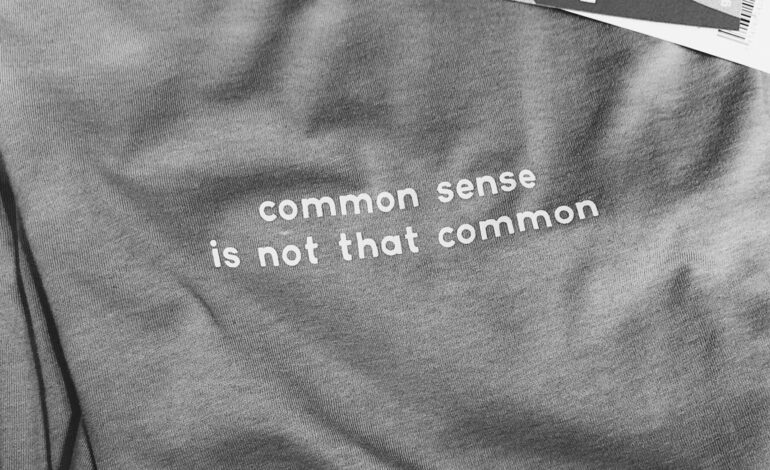
Has It Gone the Way of the Dodo?
Or Is It Waiting Where All the Lost Things Go?
I hear it almost every day.
Whether the conversation is about communication, parenting, leadership, politics, emotional intelligence, or simply getting along with one another, sooner or later, someone says:
“Well, that’s just common sense.”
The statement is usually followed by another:
“Whatever happened to common sense?”
The question always makes me smile.
In hopes that common sense has not vanished forever, I often reply:
“It’s where all the lost things go.”
The response usually gets a laugh, but beneath the humor lies an interesting question. Has common sense truly disappeared, or has it simply become harder to recognize?
The more I think about it, the more I realize that common sense may be one of the few concepts that almost everyone believes exists, yet very few people can define.
We all seem to know it when we see it.
At its core, common sense appears to be a collection of broadly shared understandings that help human beings live and work together successfully. It is not a body of academic knowledge. It is not a political philosophy. It is not a set of laws.
Rather, it is the practical wisdom that emerges from human experience.
Most people instinctively understand that honesty generally produces better outcomes than deception. Cooperation tends to work better than constant conflict. Listening is usually more productive than shouting. Trust takes time to build and only moments to destroy.
When people refer to common sense, they often mean these kinds of observations.
The challenge is that common sense can easily become confused with other ideas.
Some people equate common sense with knowing the difference between right and wrong. Others connect it to cultural traditions, social norms, or political beliefs. Still others see it as a particular way of communicating.
The difficulty is that cultures vary. Traditions differ. Perspectives change over time. What seems obvious to one person may not appear obvious to another.
This is one reason I tend to avoid framing discussions around rigid ideas of right and wrong whenever possible. Human beings are complicated. Life is complicated. Most situations contain far more nuance than we initially realize.
More importantly, all of us deserve dignity and respect, whether or not we agree with their ideas. Respect, however, doesn’t require agreement. Nor does it require us to accept every behavior. This distinction matters.
A healthy society cannot function without boundaries. Every community eventually draws lines in the sand about what is and isn’t acceptable. Violence, abuse, intimidation, exploitation, and cruelty weaken the trust and safety that relationships rely on.
The details may vary from one culture to another, but the principle remains remarkably consistent. Every person deserves respect. Not every behavior deserves acceptance.
Perhaps this is where common sense and civility meet. Common sense suggests that humans need safety, trust, belonging, and cooperation to thrive. Civility offers the tools to help us establish those conditions.
Unfortunately, much of modern life seems to pull us in the opposite direction. We live in an age of constant stimulation, endless information, rapid reactions, and growing division. Many of us spend more time defending our positions than exploring them. We are encouraged to pick sides rather than seek understanding.
When that happens, common sense can begin to feel surprisingly uncommon. But I don’t believe it has disappeared. I suspect it has simply been buried beneath noise.
When we are frightened, overwhelmed, exhausted, or angry, common sense often fades into the background. When people feel safe, connected, curious, and calm, it tends to come back.
The same can be said for civility. Neither common sense nor civility flourishes under constant pressure. Both need enough space for reflection. Both depend on the ability to pause. Both require us to remember that the person standing in front of us is first a human being and second an opinion.
Maybe a better question is not “Where has common sense gone?” but rather “What conditions allow common sense to surface?”
That question feels especially important today. The answer isn’t necessarily about finding better arguments. It might be about having healthier conversations, learning more about ourselves, and understanding what drives us. It may also involve becoming less reactive and more thoughtful.
After all, common sense isn’t always a set of fixed answers. It’s a way of approaching life—a willingness to learn, listen, consider consequences, and treat others with respect while maintaining healthy boundaries.
None of those ideas is new. In fact, they sound remarkably familiar.
That’s why we can stay hopeful. Common sense hasn’t completely disappeared. It’s just waiting quietly where all the lost things go, ready to be found again when we slow down enough to see it.