


As the frost season shortens, scientists have observed that blood-sucking arachnids commonly known as ticks are surviving longer and appearing earlier in New Brunswick.
“Warmer temperatures and changing weather are helping blacklegged ticks spread and survive in more parts of New Brunswick and Canada,” Tara Chislett, a spokesperson for the New Brunswick Department of Health (DoH), said.
According to DoH, rates of Lyme disease incidence have steadily increased since 2020.
In 2025, New Brunswick recorded its highest rate to date at 23.5 cases per 100,000 people. The government said this number is preliminary and could change as data continues to be finalized.
Over the five-year period ending in 2025, New Brunswick recorded an average annual rate of 12.3 cases per 100,000 people.
The department said that an increase in the number of reported Lyme disease cases does not necessarily mean there has been more exposure to blacklegged ticks.
Awareness and testing of the disease have improved in recent years, leading more people to seek testing and report cases; therefore, some incidents may not have been recently contracted.
Sarah Makepeace, a conservation field technician for the Nature Trust of New Brunswick, has studied ticks through her career and is currently completing her masters degree at the University of Guelph.
“We’re just going to see more ticks in general,” Makepeace said.
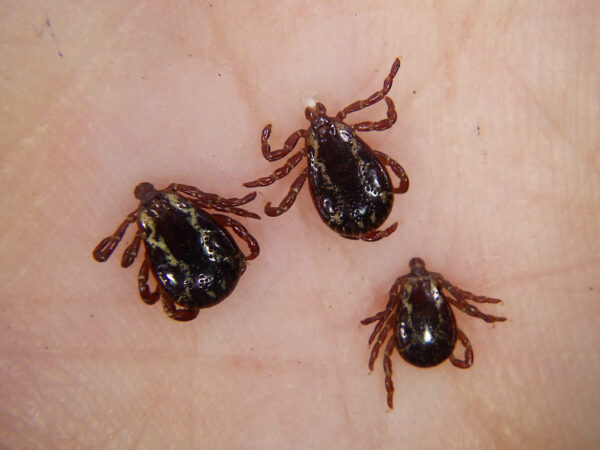
The most common tick in New Brunswick is the blacklegged (deer) tick. Makepeace said that in the adult stage, almost half carry Lyme disease.
However, she said a tick bite does not guarantee infection. She explained the risk of disease depends on how quickly the tick is removed from the skin, and if antibiotics are administered in time.
A tick can bite at any time in its life cycle. Ticks have three distinct stages: larva, nymph, and adult. As a tick grows, it is more likely to have fed off multiple animals, increasing the chance of picking up a zoonotic disease — a zoonotic disease is an infection that can be transmitted from animals to humans.
Each species of tick carries different diseases, according to Makepeace.
She said it is important to identify ticks that latch on to you or your pet to determine the risk of disease. She said minor differences in appearance are important in tick identification.
“It can be very tricky,” Makepeace said. “I recommend going to GNB (Government of New Brunswick) health.”
Public Health has a campaign on its website called Be Tick Smart. The page shows statistics, facts, and tips on how to better prevent tick bites.
The government is also partnering with a company called eTick, an application used by the public to submit pictures of ticks for professional identification.
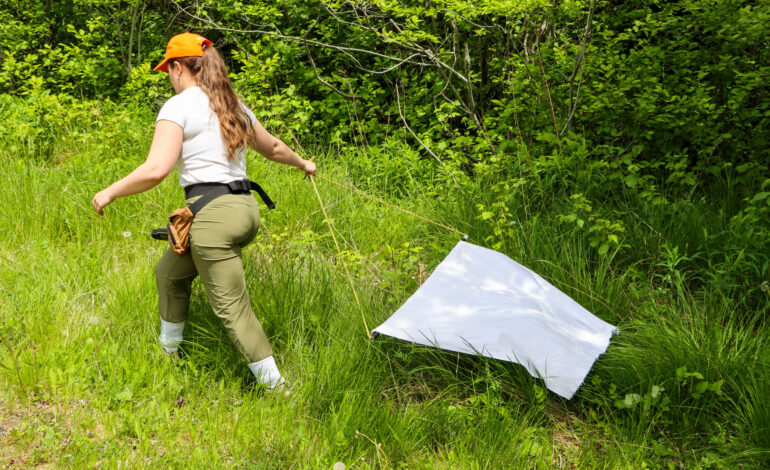
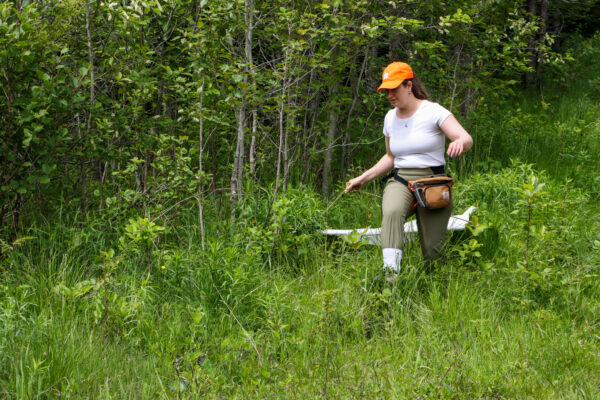
Makepeace demonstrated tick dragging, a method of active surveillance used by field researchers to study tick populations and pathogen infection.

Researchers use a 1-metre by 1-metre sheet of white cotton fabric, strung around a pole, and attached to a rope. Makepeace drags the makeshift device along the outer edge of forested areas, scanning the sheet for ticks periodically.
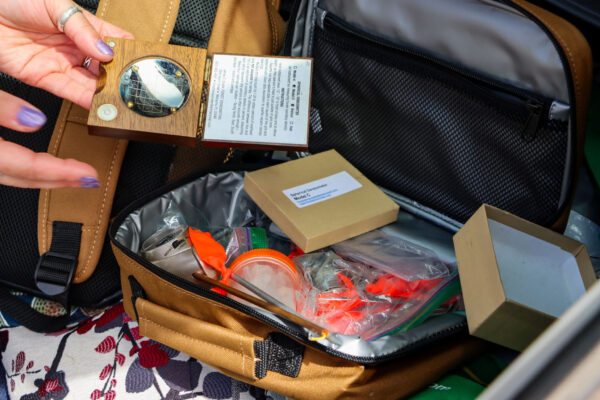
A viable study area must generate a minimum of 50 ticks. After a researcher finds a tick on the sheet, they drop it into a vial of ethyl alcohol to kill and preserve the tick for study.
Concern over alpha-gal syndrome
Alpha-gal syndrome is a zoonotic disease that causes an allergy to mammal-derived products, like red meat and meat alternatives.
This is specifically due to a sugar compound produced uniquely by mammals called galactose-alpha-1,3-galactose (alpha-gal).
The condition develops after being bitten by a lone star tick. The tick can introduce alpha-gal through its saliva into the bloodstream, prompting an immune system response and producing an allergic reaction.
The tick does not produce the sugar compound, it first feeds off a mammal, and then can transfer the compound to other animals or humans.
Lone star ticks are established in Nova Scotia, Quebec, and Ontario.
Makepeace said she is not worried about alpha-gal syndrome in New Brunswick. Lone star ticks, she explained, are not fully established in neighbouring Maine. However, much like other ticks, she said, the presence of lone star ticks will expand due to climate change.
Public Health told The Courier in an email that alpha-gal is not a reportable disease.
The sugar compound has been reported to, less commonly, be carried by blacklegged ticks in locations other than New Brunswick.
“There have been no reports of alpha-gal syndrome,” Chislett said.
Preventing tick bites
Makepeace said ticks will latch onto anything in a behaviour known as questing. A tick will raise its front legs in the air and wait for something to brush past.
That behaviour is activated by Haller’s organs, which detect heat, moisture, and carbon dioxide. All are signs of another living organism.
The tick then searches for a viable spot to bite down, typically in areas with thin skin like behind the ears, underarms, or the scalp.
In order to prevent a bite, Makepeace said individuals must be aware of how ticks behave.
“They like areas along the edge of tree lines,” Makepeace said. “They like a bit of shade, they like the taller grass, and they like more vegetation.”
The next important method to prevent ticks, according to Makepeace, is to tuck clothes in for outdoor activities.
That includes tucking pants into socks and shirts into pants. Long hair, she explained, should be tied up so the neck is visible to others.
Makepeace also said any bug repellent with DEET will keep ticks away.
“Do a tick check of yourself, check your pets, and then before you go to bed that night, do another tick check. Because they’re hard to spot and they’re easy to miss,” Makepeace said.
She said she isn’t overly concerned with tick populations yet, but she thinks there needs to be more awareness in the province.
“I think just being more aware of what environments you’re in and the risk that ticks pose, I feel like that’s more helpful and useful than being concerned about them,” she said.