

By Paula Horvath
Community Contributor
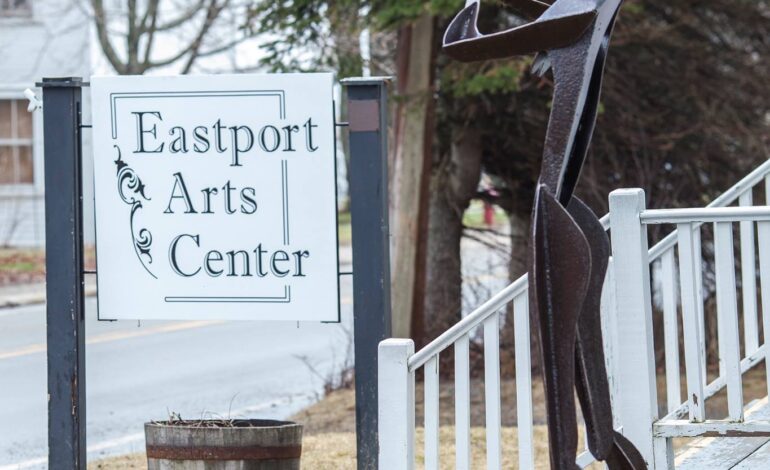
Eastport Arts Centre
The bays and inlets that surround coastal Canada and the rivers that supply them are a source of life for Maritimers. That’s why it’s so important to protect and restore them for future generations.
Both the successes made and the challenges yet to be faced will be the topics of an event to be held in Eastport, Maine, between May 1 and 2. The event is titled “We Are the Watershed.”
It was coordinated by numerous conservation and Indigenous groups to explore how people on both sides of the international border can work to safeguard their waters.
“We want to come together as people who are deeply connected to nature to talk about how we can move forward as a collective to heal people, wildlife, and nature,” Bethany Pohl, Marine Conservation Coordinator for the Passamaquoddy Recognition Group and head of the consortium planning, said.
Over a dozen groups from Maine and Canada – all connected through their conservation work — are part of the event consortium. These organizations range from the Peskotomuhkati Nation, which has led much previous conservation work, to Wabanaki REACH, from the Downeast Salmon Federation to Maine’s Cobscook Institute.
Pohl said she hopes the May event will introduce people to the challenges facing the watershed, which covers some 4,221.67 square kilometers (1,630 square miles) in Canada and the United States. She also hopes people who come to the event will be willing to join others in working to preserve their ecosystem.
She and others note that it’s been the collective work of dedicated individuals and groups that’s been the catalyst to restore ancestral fish populations in the area. In particular, the decline of alewife and herring populations has been turned around in the last two decades.
“This is a place where people used to say you could once walk across the (Skutik) river on the backs of fish,” Fundy Baykeeper, Matt Abbott of the Conservation Council of New Brunswick, said. “Or, people used to say, there were so many fish you could hear them before you could see them.”
Historically, over 50 million herring and alewives once migrated upriver annually. That migration effectively ended with the construction of several dams and by 2002, the migrating population had shrunk to 900.
But, since then, thanks to hundreds of like-minded people, migrating populations of fish have climbed to over a million.
“It’s a success story,” admits Alexa Meyer, the conservation manager of aquatics for New Brunswick’s Passamaquoddy Recognition Group. “Although we certainly have challenges ahead. Right now, there’s so many pressures on species.”
Abbott and others hope to continue the good fight that won the battle for the alewife to confront the watershed’s newest challenges. “What I’ve learned is that it’s the human relationships that are the keys to making good things happen,” Abbott said. “So this notion of ‘We Are the Watershed’ really seems to capture what I’ve seen is effective.”
To urge more people to join together to protect the watershed, the planning consortium is inviting people to attend the Eastport event to both learn about the watershed and get involved
The free event will begin on May 1, at the Eastport Arts Center, 36 Washington St. in Eastport, Maine, with a celebration of visual and written arts that’s been especially created to illustrate people’s deep connections to the watershed. The EAC’s doors will open at 6 p.m. to allow visitors to see a wide collection of arts on the walls and hear from the poets, all of which have been published in a special book made available that evening. Musicians from both sides of the border will accompany the poets’ verse.
“I am not a scientist, but this is a place where I can contribute my voice,” explains Alison Bryn Ross, the director of the Eastport Gallery and the person behind the art-focused component of We Are the Watershed. “An artist’s job is to share their own perspective of the world, so it’s an opportunity to see those perspectives.”
The event’s second day will begin at 10 a.m. and be filled with both information and entertainment. Refreshments will be provided.
The many organizations taking part will have booths set up in the EAC to take questions and, in some cases, involve attendees in on-site activities. A panel discussion involving many of the participants will take place from 10:30 a.m. to 11:15 a.m., documentaries regarding the watershed will be screened, and appearnces by the Thunder Women from Sipayak — Cipelahq Ehpicik – and Passamaquoddy Language Keeper Dwayne Tomah.
The day will end with a special presentation at 2:30 p.m. of an interactive play inspired by the St. Croix River, the Passamaquoddy Bay and its watershed – Becoming Seagrass. The play ends with a Snake Dance in which everyone is invited to take part.
“It’s a collaboration between neighbors that reaches across the border bringing an awareness of our environment,” says Brian Altvater Sr., Schoodic Riverkeeper. “When we look at the ecosystem, we’re at a point where if we don’t do things collectively, some things may be irreversible.”