


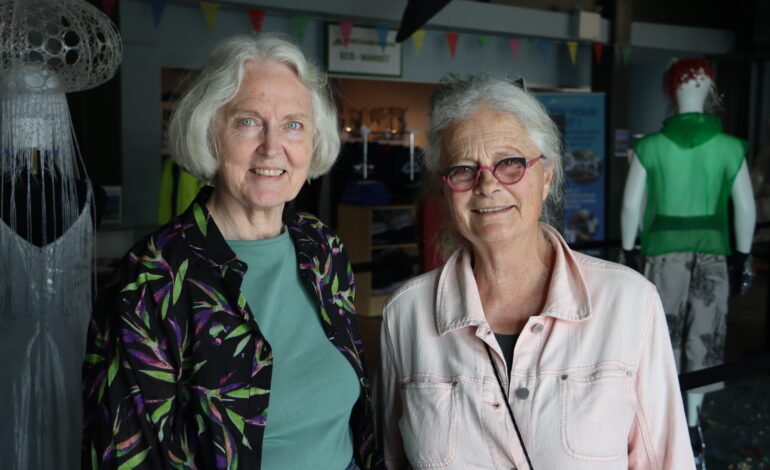
Under the belly of a North Atlantic right whale, inside the Huntsman Marine Science Centre, is a collection of things that cannot be disposed of — created by local artists Carol Miller and Alanna Baird.
Baird and Miller brought Indisposable — a fashion exhibit highlighting the impacts of pollution.
The clothes in their exhibit were crafted almost entirely of recycled materials or second-hand items.
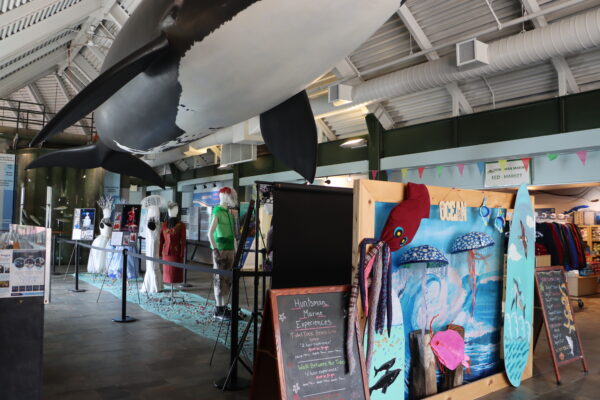
Their pieces showcased styles through six different eras in human history, beginning with the French Revolution.
“My first inspiration was to start as far back as I could think would be the first time when we started to abuse our oceans,” Miller said.
The exhibit evolves through the Industrial Revolution, then to the 20th century. Miller and Baird feature the 1940s — when women entered the workforce – and carried through to the 21st century, ending with the world’s latest trend, fast fashion.
Fast fashion is buying clothes, only to use them once or twice, then throw them out or buy new ones.
The exhibit was originally pitched to a show in Calgary, Future Oceans International – Awaken New Depths, where clothing was worn and displayed by models.
“Seeing your clothing move and seeing dresses swish and seeing the models have fun wearing it was really exciting,” Baird said.
World Oceans Day is an annual, global event on June 8. The day aims to raise awareness about protecting the earth’s oceans.
“It’s a time to reflect on what we have surrounding us and that we should pay more attention and, to take more care about (the ocean),” Miller said.
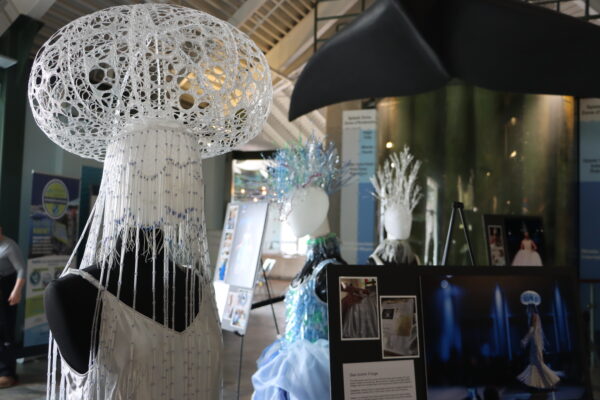
Through the exhibit, Baird and Miller showcased invasive species like tunicates, lionfish, among others. Trash, Baird explained, is also invasive and was a critical piece of their artwork.
Both Baird and Miller talked about taking inspiration from living close to the ocean.
Sprinkled along the cat walk were lobster bands, many of which Baird found walking along the Saint Andrews beaches.
“And this morning, walking my dog, I picked up 20 rubber bands between the lighthouse and the first exit off Chandler Street,” Baird said.
Baird said despite that, the area has fairly clean beaches.
“We have a population who cares about our ocean, who picks stuff up, and who get it closer to where it should be,” Baird said.
While the exhibit is not permanent, both Baird and Miller hope Indisposable serves as a reminder of what cannot simply be thrown away.