

When Maud was young, she possessed the sort of energy usually reserved for toddlers after birthday cake or people who insist they “don’t drink coffee” while downing Red Bull like life support.
Every morning she woke up fully charged while my husband Patrick and I were still negotiating consciousness and wondering whether adulthood was supposed to feel this relentlessly early.
I love walking. I’m one of those people with a daily step goal on my iPhone that I proudly show friends like it’s the equivalent of a clean bill of health — proof that I’m thriving.
10,000 steps? Easy. For young Maud, however, that was merely the warmup before the actual Olympic event.
Walks with her were less peaceful stroll and more like an out-of-control dog sled team. At the sight of a squirrel, she’d lunge with such excitement that I was routinely dragged into ditches, across strangers’ lawns, and once, I believe, into a family barbecue that hadn’t been planned for additional guests.
No matter how far we walked, Maud still radiated the pent-up energy of someone who had recently tunneled out of prison using only determination and a spoon. I wasn’t sure if she needed more exercise or an exorcism.
So I decided we’d try fetch.
I had seen other dog owners enjoying wholesome park experiences with obedient retrievers. The dogs would chase the ball, return the ball, and sit patiently awaiting the next throw. How civilized.
So we began with a tennis ball. Maud understood the assignment immediately and then chose to reinterpret it.
“I’m only a half golden retriever,” her expression seemed to say. “The poodle side has concerns.”
To her credit, she retrieved the ball beautifully. She soared through the air like Simone Biles. That’s when fetch transformed into a post-heist police chase.
She’d stand 20 feet away staring at me with the detached confidence of a seasoned criminal.
You want this back? Interesting. Let’s discuss terms.
The tennis ball itself became secondary to the larger event, which was apparently called Watch Your Middle-Aged Parents Publicly Display Their Lack of Authority While Pulling a Hamstring.
When I finally gave up from exhaustion, she’d collapse into the grass and slowly dismantle the tennis ball with the concentration of a surgeon and the emotional detachment of a mob enforcer. First the yellow fuzz. Then the seams. Then the tiny rubber organs inside.
So we got her a frisbee.
Not just any frisbee — an indestructible frisbee recommended by Gail Smith at the Crocker Hill Store in Saint Andrews. It couldn’t be shredded. More importantly, it was large enough to theoretically pull from her mouth.
At last, I thought, I’d outsmarted her.
Maud took to the frisbee instantly. I threw it with everything I had. She hurled herself through the air with shocking skill and terrifying commitment, twisting midair like she was the Rob Gronkowski to my Tom Brady.
The only issue was she still refused to give it back.
By the next day, I had talked myself into believing that two frisbees might succeed where human reasoning had not.
“With a second frisbee,” I told Patrick, “she’ll have to drop one to get the other.”
I threw Frisbee Number One. Perfect catch. Then I dramatically launched Frisbee Number Two across the yard.
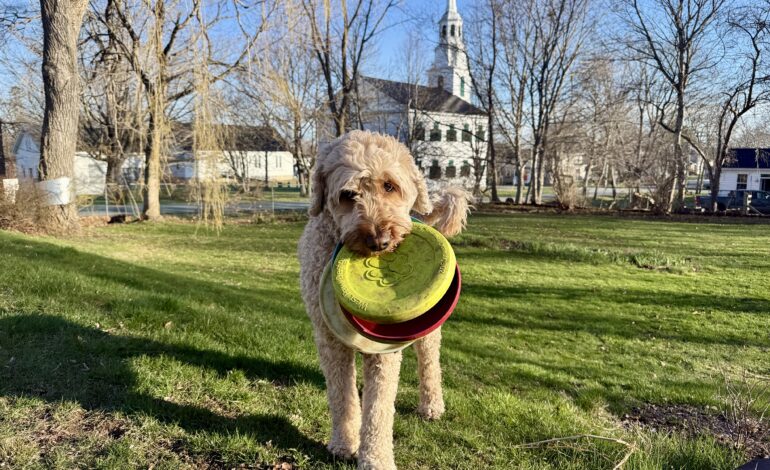
Maud instantly responded, sprinting toward it with the first frisbee still in her mouth. Instead of dropping Frisbee One, she waited for Frisbee Two to land on the ground. Then she placed Frisbee One directly on top of it like she was stacking serving platters at a banquet hall, and picked up both.
Rather than accepting defeat, I escalated. Back to Crocker Hill I went. Then back again. Soon we were up to five frisbees, which appeared to represent the upper limits of canine mouth engineering.
“She can’t possibly carry six,” I told Patrick.
At this point, the situation no longer resembled pet ownership so much as a deeply personal competition I was losing to someone who still occasionally chased her own tail.
So naturally, I added one more.
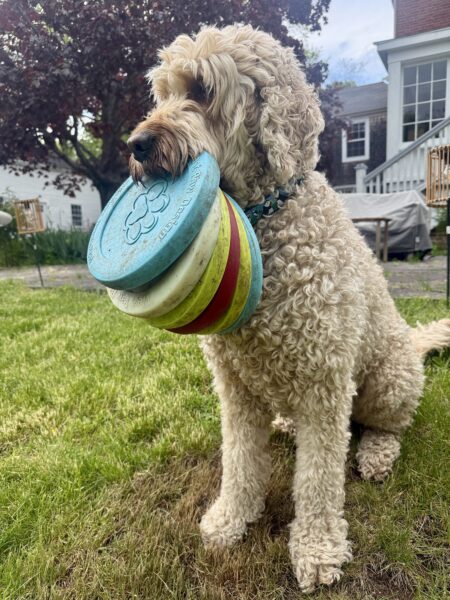
Maud struggled briefly with the geometry of it all, using her paws to compress the stack with the concentration of someone trying to close an overstuffed suitcase at the airport.
And then, somehow, she got her mouth around all six.
She couldn’t exactly run with them. She shuffled forward with the solemn determination of a pack mule crossing a mountain range. But the effort itself became strangely moving.
I could have easily taken the frisbees from her then. Instead, I found myself rooting for her the way people cheer for Joey Chestnut breaking a world record. Once someone commits that completely to an objectively ridiculous task, it somehow circles back around to being impressive.
Eventually Maud marched triumphantly into the house and deposited the frisbees beside her water bowl as if to say, touchdown.
Then she drank water while keeping one eye fixed suspiciously on her trophies just in case I attempted a theft.
But I didn’t want to anymore. Clearly, this was how the game – our game – was meant to be played.
This is still her ritual.
Actually, it’s our ritual.
We don’t play as many rounds now because middle age finally caught up with all of us. But her inner puppy remains permanently available for recreation. And over the years, we’ve become surprisingly good at frisbee together.
Her frisbees remain her favourite possessions. Sometimes she sleeps beside them protectively, using the neatly stacked pile as a pillow. And honestly, I think she loves them because frisbee represents something adults quietly abandon without noticing: pointless fun.
Before Maud, I could barely throw a frisbee. Now I can hit a target across the yard with disturbing accuracy — a random skill acquired solely because a wild and tireless puppy drafted me into recreational athletics.
But somewhere along the way, I realized Maud was right.
Adults spend their lives trying to optimize themselves into joylessness. We count steps, monitor sleep, track hydration, and turn our lives into ongoing administrative projects. Meanwhile, my dog hurls herself through the air every evening for no reason other than delight.
And maybe that’s the embarrassing truth dogs expose about the rest of us: not that they are simpler than humans, but that they remain fully committed to things we slowly train ourselves to outgrow.
Joy. Play. Obsession. Running simply because it feels good to run.
Maud has never once concerned herself with step counts or fitness goals. She gets all the exercise she needs as a side effect of throwing herself wholeheartedly into things she enjoys.
Somehow the dog who still occasionally chases her own tail arrived at that understanding long before I did.