

I don’t have to ask Maud if she wants to go outside. All I need to do is zip up my coat, and to Maud it may as well be the starting pistol at the Kentucky Derby.
She appears at once, as if conjured. Whatever she was just doing—napping, lounging, or conducting high-level squirrel surveillance with the focus of an air traffic controller—is abandoned without hesitation. We are going outside.
Before we leave, she performs what I can only describe as a pre-walk carb-loading ritual. Back and forth to the food bowl. A mouthful of kibble, then a quick return to the door to make sure I haven’t betrayed her. Repeat. It has the anxious energy of someone eating dry cereal over the sink before a marathon they signed up for without any real preparation.
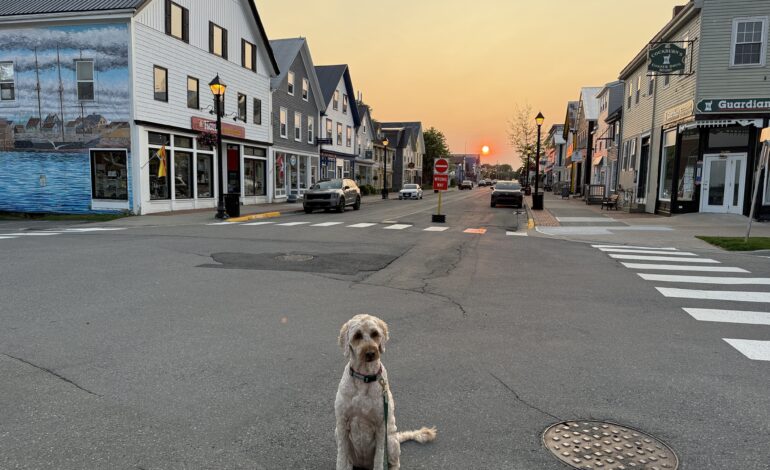
We live on Water Street in St. Andrews, which means going outside is less of a private activity and more of a low-stakes public appearance. You will see people. People will see you. There is no opting out unless you’re willing to army crawl behind parked cars, which I’ve considered on the odd bad hair day.
Maud, however, thrives in this environment.
She approaches strangers with the confidence of someone who believes she has been expected. There’s no hesitation, no polite internal debate. She looks directly at people as if to say, This is happening now. And just like that, it is.
A glance becomes a hello. A hello becomes a conversation. I stand there holding a leash while Maud facilitates what feels like a town hall meeting.
Dog people fold immediately. They’ve been training for this moment. Names are exchanged—usually the dogs’ first, which feels right, given who’s actually running the interaction. Then come the details: age, breed, allergies, emotional baggage. You learn more about a stranger’s dog in 90 seconds than you might learn about the stranger in a year, and somehow it feels more honest.
But it’s not just dog people.
A dog is a social loophole. It gives you a reason to stop without admitting you want to. You can stand on a sidewalk talking to someone you’ve never met, and no one has to explain why. The dog has filed the paperwork. Also, the dog is, without question, the more compelling conversationalist—always ready to step in when the small talk starts to die a quiet, dignified death.
And in those pauses, something shifts.
The street stops being a place you move through and becomes a place you’re actually in—which sounds obvious until you realize how rarely it happens anymore.
Because we don’t really arrive at the world by chance anymore. We route ourselves to it.
We don’t wander into restaurants—we read 147 reviews and decide in advance how much we’ll enjoy the pasta. We don’t meet people—we screen them. Dating apps, LinkedIn profiles, curated bios that make everyone sound both accomplished and exhausting. Even getting somewhere requires permission from a calm, disembodied voice telling you exactly where to turn and when. Recalculating, but never wondering.
We don’t follow the street to see what happens. We follow instructions. We believe artificial intelligence knows best.
And by the time we get there—wherever “there” is—we’ve already decided what it will be like, who we’ll meet, whether it’s worth our time. We’ve removed the possibility of being wrong, which is also the only way to be surprised.
There’s no algorithm on Water Street. No rating system. No way to pre-screen the man you’re now speaking to about his beagle’s digestion, whose name you didn’t catch and are now too far in to ask again without exposing yourself.
It’s inefficient. It’s occasionally uncomfortable. It’s also where the interesting part lives.
Because without all that filtering, you get something else. Something unscripted. A moment you didn’t plan for. A person who doesn’t match your expectations and doesn’t seem particularly concerned about it.
Maud doesn’t curate her experience. She assumes the world is available and that the people in it are part of the offering. She doesn’t hesitate or wonder if it will be “worth it.” She just goes in, fully, every time, like it might be the entire point.
By the time we turn back, she’s done whatever it is she came out to do. I’ve had three conversations I didn’t plan on having and learned the name of a terrier with a more active social life than I have.
Back inside, the leash comes off. The house goes quiet. But Maud knows—and I know—that the zipper will close again.
And when it does, she’ll appear. Certain as ever. Ready.
Because she is absolutely convinced that something is always about to happen.
And, as I’ve come to learn, she’s usually right.