


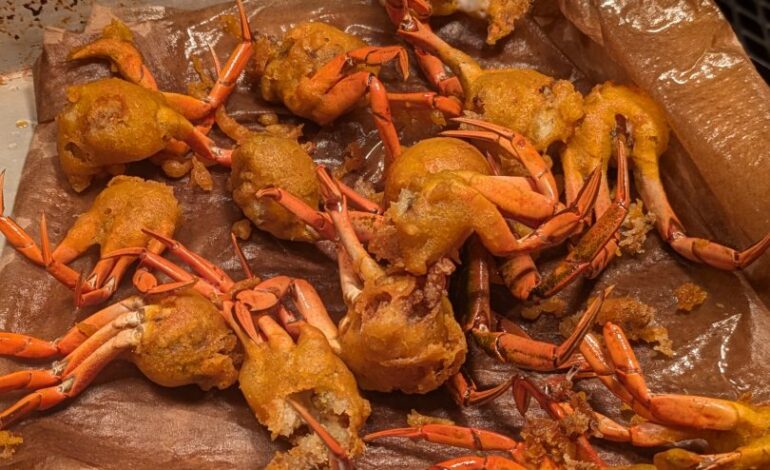
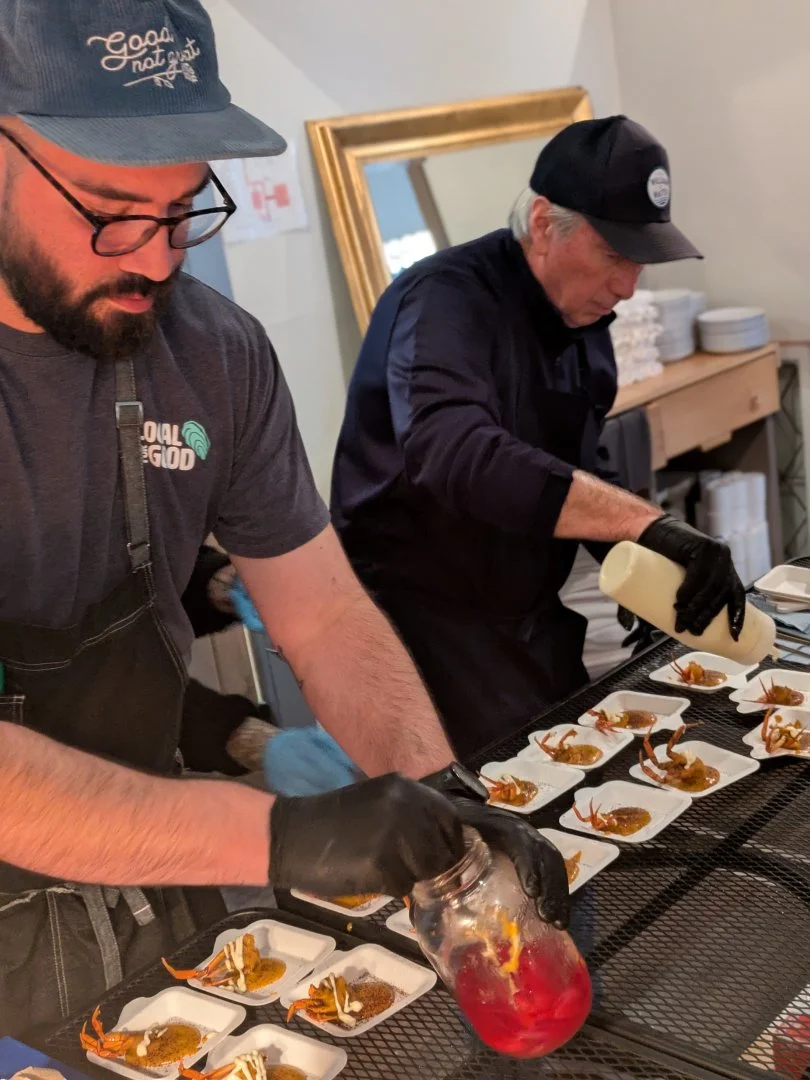
Visitors to the annual Indulge Food and Wine Festival in Saint Andrews this year were treated to a unique dish at the William & Water restaurant — fried invasive European green crabs in a tempura batter.
Chef Will Thornton said the crabs, which are a delicacy in Venice but not typically eaten in North America, were well received by those who tried them.
“We had a good response,” he said. “The uniqueness of the dish was the main reason people were interested — people knew about them but most didn’t know you could eat them.”
European green crabs first arrived on the mid-Atlantic coast of North America a little over 200 years ago, transported like many aquatic invaders, as larvae in ship ballast water. They reached New Brunswick and Nova Scotia in the 1950s and are now one of the most common crabs on the East Coast, from Long Island Sound to Newfoundland. By the late 1990s, they had even begun to appear on the Pacific Coast of British Columbia.
The crabs can devastate the local environment. They devour native clams and oysters, as well as juvenile crabs, lobsters and small fish, and they compete with native Jonah crabs and lobsters for food. They also burrow into the seabed, destabilizing the mudflats and eelgrass meadows where many native species live.
Unfortunately, when it comes to dealing with the invaders, the boat has sailed on getting rid of them entirely. They are hardy creatures, able to survive out of the water for five days or more, and are prolific breeders: female crabs can release up to 185,000 eggs twice a year.
In the spring of 2026, Fisheries and Oceans Canada (DFO) launched a commercial fishery pilot for green crabs in southwestern New Brunswick, offering free licences for harvesters with active licences for another species. So far, they have mostly been used as a free alternative lobster bait, but there are also efforts underway to get them onto Canadian dinner plates.
“Since we can’t control the species, we might as well eat them,” said Owen Jones, business growth officer with the New Brunswick Department of Agriculture, Aquaculture and Fisheries (AAF).
Thornton was approached by Jones and Clinton Pendleton, a fisherman from Deer Island, with the idea of featuring the invasive species on his menu to help kick-start a culinary market for the crabs.
“Saint Andrew’s has lots of fine dining restaurants and chefs who are open to using new species and who like the environmental angle, so we thought it was the best place to put our efforts,” Jones said.
The crabs can be difficult to work with. They are small and don’t have much meat on them, and what meat there is is in the body rather than the legs as most people are accustomed to. If they are caught at the right time and kept until they moult, they can be used as the Venetian soft-shell crab delicacy known as moeche, but that is a tricky and time-consuming task. So most chefs tend to use them in soup stocks. Thornton, though, didn’t want to settle for a simple stock.
“To help promote them as a food I didn’t want to just make soup; I wanted to showcase that you can eat them,” he said.
Diners at William & Water should expect to see green crabs on the menu again soon. Thornton will keep working on improving the Indulge dish, and has plans to introduce a green crab cocktail — a version of the classic Caesar using crab stock in place of the clam juice in Clamato.
“It’s a great product; the flavour is amazing,” he said. “I don’t see why we shouldn’t be eating these things.”
And the environmental story, he added, is an extra bonus. After Indulge, ‘there are now 400 fewer green crabs in Passamaquoddy Bay,’ he said.