

By Andrew Bates, Local Journalism Initiative Reporter, Telegraph Journal
Three citizens opposed to rezoning land for the Spruce Lake Industrial Park say new legal action is their “only option” to stop the project.
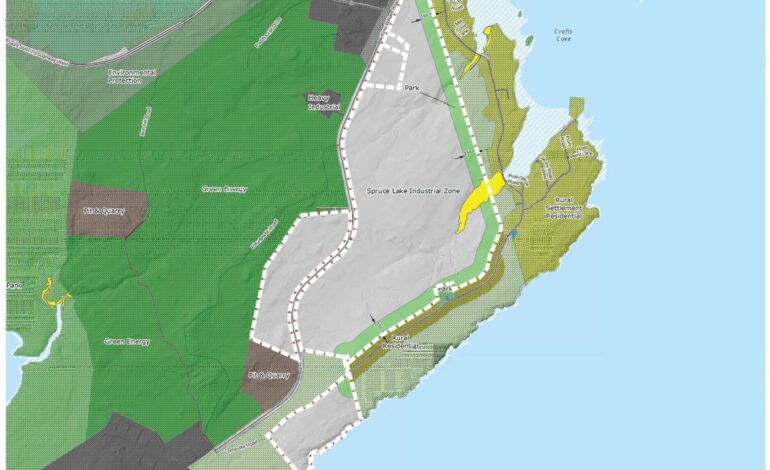
Adam Wilkins, a member of the Save Lorneville community group, told Brunswick News he and two other people served the City of Saint John last week with an application for judicial review regarding council’s decision to approve rezoning and municipal plan amendments regarding a 510-hectare parcel of land land adjacent to King William Road. The city is in talks to acquire the land from the province to expand the Spruce Lake Industrial Park in an effort to create development-ready properties and encourage industrial growth.
Brunswick News viewed the application, which was filed with Saint John Court of King’s Bench Oct. 6. Wilkins, Chris Watson and Shayne Galbraith, as applicants, are asking a judge to overturn the decision, arguing councillors breached procedural fairness by failing to approach it with an “open mind,” and that it contravened parts of the city’s municipal plan, according to the application.
“It was our experience, and it was quite apparent, that this was a decision that was already done before going through the actual process,” Wilkins said Friday, adding “This is the only option we had to continue to push back from a legal perspective.”
The allegations in the application have not been tested in court, and a reply to the application from the city has not been filed. The City of Saint John has declined comment, according to spokesperson Sarah Peiser, saying the matter is before the courts. A case management conference is scheduled for Nov. 7, Wilkins said.
The vote to approve rezoning in July came as part of a year-long process that began June 2024, with a public hearing postponed in October to establish a series of task force meetings last winter, before public hearings in May and June 2025, which saw about 120 residents speak against the project. Concerns raised include loss of wetlands, environmental impacts, and impacts to flooding or groundwater wells.
The rationale for the proposal includes a “critical shortage of development-ready industrial lands” in the city. At the public hearing, Spruce Lake Industrial Park general manager Ian MacKinnon said the organization has fielded interest on projects including a data centre and a green manufacturing project, which could generate millions in tax revenue annually.
After the task force meetings, changes to the project included increasing a park buffer from residential homes from 30 to 150 metres and a groundwater monitoring plan. Changes to the zoning also include a 250 to 500-metre setback for industrial or heavy industrial uses.
A provincial environmental impact assessment review for the project to clear “pad-ready” land on a 107-hectare part of the site wrapped up in August, when the province approved the project with 23 conditions, including to complete a stormwater management plan, monitoring plans for groundwater, surface water and wetlands, and an environmental management plan.
That part of the project included about 53.9 hectares of wetlands, and the developer was required to obtain a provincial wetlands and watercourse alteration permit as well as to compensate loss of wetlands at a 2:1 ratio.
The notice of application details the city and province’s steps in developing the project, meetings of the task force committee, and comments from councillors and Mayor Donna Reardon about the project both in media and to residents. The applicants argue these are evidence that some councillors had a “closed mind” regarding the project.
The application argues that failing to proceed with an open mind is a breach of procedural fairness. When asked what legal authority they’re drawing on to define that, Wilkins said that there wasn’t one “that we know of.” He said they’re using evidence and examples from the public record to “highlight that they weren’t open to this.”
Wilkins told Brunswick News the city “didn’t fairly balance concerns” brought up at the public hearings or make changes, and said there was a “quite clear bias towards approving the project.”
When asked about the decision to postpone the initial public hearing and assemble the task force, Wilkins, who had been the co-chair of the task force, said that questions wouldn’t be answered or promises would change week to week, adding that “every step of the way, it was not giving answers, not respecting the community.”
He said this differs from the normal course of how a municipality would proceed with a project because of the “sheer enormity” of the project area and developments regarding wetlands and old growth trees in the area.
The application notes that the city denied a rezoning to J.D. Irving, Limited to rezone part of Wolastoq Park for offsite parking as part of the mill expansion, in part because of the need for a buffer between heavy industry and residential use.
“All of those points and arguments and soundbites and approaches were used in that controversial case as a way to not develop that parkland,” Wilkins told Brunswick News. “But then none of those were applied in this instance, when it was closer and even more at-risk.”
When reached for comment, Reardon declined, saying it would be inappropriate to comment on the application before the courts, but spoke of “harassment, bullying, personal attacks” towards councillors online in relation to the industrial park file. In June, Coun. Brent Harris said he was accosted after a vote by people opposed to the project, with security personnel having to intervene.
The application also alleges the city has breached its own municipal plan, which limits changes to proposals which satisfy six criteria, including that they are “consistent with the general intent” of the plan, that they do not “negatively impact the use and enjoyment of adjacent lands and neighbourhoods” and that any proposal “adequately addresses and mitigates any significant environmental impacts.”
The application alleges that the plan “will lead to the destruction of vast amounts of wetlands, old growth and mature forest, and remove climate resilience benefits,” and suggests that the expansion is “incompatible with both the character of the neighbourhood and the broader land objectives of the city.”
Reardon said in August that both “growth” and “green” are in the city’s priorities, saying “we want to balance that ourselves,” being “diligent” going forward and offering more committee participation for residents.
“Where does it go to follow all their guidelines and suggestions, and respect the environment and still work?” Wilkins told Brunswick News. “I don’t know how it’s possible.”