


Property tax reform recently released by the provincial government in New Brunswick has fallen short for some municipalities expectations.
“We supported as an association the goal of creating a fair, transparent, predictable and stable system,” Brittany Merrifield, the president of the Union of Municipalities of New Brunswick, said. “The reforms that came through last week didn’t do that. [It] didn’t address any of our key priorities.”
Fiscal reform remains uncompleted following the 2023 amalgamation of several local governments in the province — part of that reform was through property tax system — where municipalities get 85 per cent of their revenue.
The government made several changes including maintaining the spike protection mechanism. It caps the increase on a particular property at 10 per cent. If the assessment rises above the 10 per cent, the new assessment amount is phased in over subsequent years.
“We talked about fixing the growing inequities created by the spike protection mechanism,” she said, speaking with The Courier. “It didn’t address exemptions, some of which have been in place for multiple decades.”
Those exemptions, Merrifield explained, had left residential tax payers to fill the gap. The province also did not decouple residential and non-residential (or commercial) rates. That change would have allowed municipalities greater autonomy to independently adjust the rates in different classes.
“I think what we’re going to see as we move into 2027 and the municipal budget this fall, is that municipalities are going to be cognizant of that, and they’re going to try and take advantage of lowering their tax rates for residents.”
“There is a lot to unpack there, but we were particularly disappointed that this legislation did not address any of those issues,” she said.
One of the major changes includes the province having more control over setting local tax rates. The province will publish tax rates for each municipality — with an automatic adjustment to lower it when assessment rises above inflation — and should a local government decide to change it they must justify that decision to the public and the minister.
“There’s a very heavy provincial hand on the wheel there which certainly does not increase the autonomy of municipalities,” Merrifield said. “We’re already the most transparent and accountable order of government when it comes to what our fiscal situation looks like.”
She said the cost of maintaining infrastructure continues to rise.
“In terms of justifying it, we’re already doing that,” she said. “We do it at an open session of council and frankly I do it every time I walk the dog, every time I’m in the grocery store and every time I’m at a kid’s sports competition. So that justification piece is already there.”
She isn’t alone in that criticism.
Represents overreach
Fundy Shores Mayor Denny Cogswell also took aim at the new rules around tax rates.
“While we understand and appreciate the province’s intention to lower tax bills and address affordability concerns for property owners, municipalities must retain the ability to make local financial decisions based on the needs of their communities,” he said in a statement sent to The Courier.
He said in the statement the one-size-fits-all approach undermines municipal autonomy.
“It appears that the province, in an effort to lower tax bills for property owners, may effectively be telling municipalities what rates they should charge. We disagree with this approach, as it represents an overreach into municipal governance,” he said.
Saint Andrews Mayor-elect Steve Neil said he agrees with the position taken by UMNB.
“The province’s plan does feel like it is putting the burden back onto the municipalities and falling short of what most were hoping for, that being a true reform of the property tax system,” he said in a statement.
Municipal District of St. Stephen (MDSS) Mayor Steve Backman said the changes won’t affect them much in terms of the justification piece .
“We look at what we want to do, and then we cost it out, and then we see if that fits in with our expectations, and we set the tax rate so that we can achieve that level of income,” he said, speaking with The Courier.
He said at the same time the cost of dealing with infrastructure, the housing crisis, homelessness and public safety continues to rise.
Opposition tackles reforms
The reforms were debated during question period at the New Brunswick Legislative Assembly this week, with the opposition taking aim at the Liberal government’s approach.
“It will have a budgetary impact on municipalities,” said Interim Progressive Conservative Leader Glen Savoie. “While this government tries to paint municipalities as irresponsible, putting more economic restraints on municipalities will make it more difficult for them to deal with infrastructure shortfalls.”
Savoie asked for the bill to be sent to the Law Amendments Committee.
Local Government Minister Aaron Kennedy, the former chief administrative officer for the Town of Quispamsis, said some municipalities support the reforms.
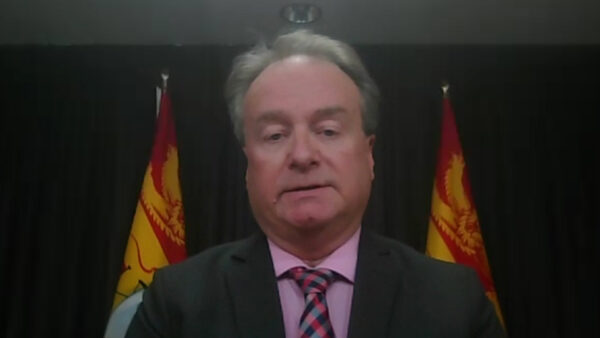
“We are going to put changes in place that [are] going to make the system more predictable, stable, transparent and fair for New Brunswickers,” he said in the house on Thursday.
Kennedy was asked by PC MLA Mary Wilson in what circumstances he would deny or approve a rate change against the province’s stabilizer mechanism.
“They (municipalities) will be able to show that to them (the public),” he said. “Residents will be able to see that and residents will be able to accept that. Municipalities are not being capped on what they can set as their tax rate, they are free to continue to do that as they have been throughout.”
Municipalities did receive more provincial funds this year, but not the diversification it was seeking for its revenue.
Merrifield said in neighbouring Nova Scotia, local governments are only reliant on property tax for 63 per cent of its revenue. In Alberta, that figure drops to 44 per cent.
“New Brunswick municipalities have a $2.5 billion infrastructure deficit and that’s just dealing with existing infrastructure,” she said. “I know the province wants us to build new infrastructure, especially housing, but I don’t see how that is going to happen.”
She said the UMNB and other municipal associations will continue to advocate for further reform, including diversification of revenue streams.
Minister stands by reforms
Local Government Minister Aaron Kennedy told The Courier in an interview that the government was trying to come up with a system that is more stable, predictable, transparent and fair for homeowners.
“Municipalities certainly have been well served by this government during my time as minister,” he said. “We came forward with a fiscal reform package this year that gave them an additional $63 million in revenue, new money. That certainly helped them.”
He said the government has now turned its attention to homeowners who have been expressing frustration and concern over the rising cost of property tax bills.
Kennedy said he respectfully disagrees with the idea the rate stabilizer mechanism is “government overreach.”
“To me, we could have made a revenue-neutral model and then require municipalities to raise their rates,” he said. “But we have come up with a formula that allows municipalities to lower their rates.”
He explained if a municipality finds the stabilizer rate doesn’t work for them, they can raise it.
Kennedy was asked about the circumstances under which he would approve or deny a tax rate increase.
“I think what we’re going to see as we move into 2027 and the municipal budget this fall, is that municipalities are going to be cognizant of that, and they’re going to try and take advantage of lowering their tax rates for residents,” he said.
He said there is more legislation coming in the fall regarding the diversification of revenue, including the vacant land levy.
“Municipalities have asked for that,” he said. “The other revenue stream is the heavy industrial revenue grant that will be coming forward in time for the 2028 tax year.”
Kennedy explained there are 29 municipalities that will benefit from that grant.
“We provided the municipalities with $63 million more this year and now it is important that we look after the homeowners of New Brunswick,” he said. “They are the ones that have borne the brunt of this.”


