

On Grand Manan, time does not so much pass as it settles.
You feel it the moment the ferry pulls away from the mainland, when the shoreline softens and the horizon opens, and the world you’ve left behind—its noise, its urgency, its fluorescent insistence—begins to feel faintly theoretical. Here, there are no chain stores, no neon signs competing for your attention. There are wharves and weathered homes, lobster traps stacked in colourful rows, and majestic sea cliffs with nothing but ocean beyond.
And then there is Vera Green.
At 103, she is, by all accounts, the oldest living islander—a fact she confirms only when asked, and even then with a kind of polite disinterest. “I don’t think much about it,” she says, seated in her daughter Sheila’s living room, where the window stretches wide across the Bay of Fundy like a painting that refuses to stay still. In the distance, Swallowtail Lighthouse stands quietly against the sky.
Vera glances toward it, as if checking in with an old friend. She has looked out at this view countless times. She has never tired of it.
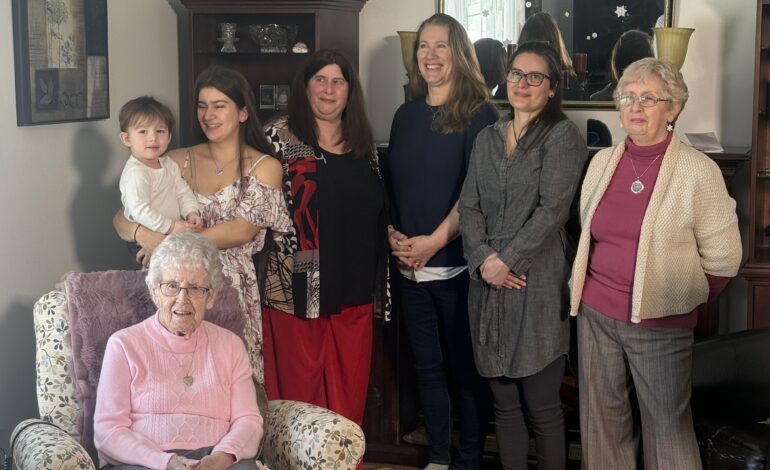
The house is full when I visit. Six generations gather in the same room: Vera; her daughter Sheila, who is 80; Sheila’s daughters Vicky and Sonya; Sonia’s daughter Haze; Haze’s daughter Ocean; and Ocean’s son, Phoenix—a baby and the first boy to arrive after what feels, in family lore, like a dynasty of girls.
It is, as someone points out, a straight line of daughters until him.
Vera laughs when asked what it feels like to preside over such a family.
“I’ve got so many,” she says, the sentence dissolving into laughter. “And I love them all.”
There is no performance for her. No grand speech about legacy. Just a matter-of-fact tenderness that seems to have shaped everything around her.
If Vera is the island’s matriarch, she is also its memory.
She has lived a life that stretches across eras most of us encounter only in textbooks—through war, through cultural shifts, through the quiet transformations of everyday life. But she recalls it all not as history, exactly, but as experience.
Her childhood would read, today, like fiction.
“We lived in a tar paper shack for three winters,” she says, describing the early years when her father worked on a pulping project. “We didn’t have an easy life, but we had a good one.”
There is no self-pity in the telling. No embellishment.
Her mother died when she was young. Her father worked hard, cutting wood with horses. They walked long distances to school. For a time, they lived with a dirt floor beneath them.
“I’m not ashamed,” she says simply.
What she remembers most is not hardship, but love.
Sheila, sitting beside her, fills in the spaces her mother leaves untouched. When Vera speaks of a 67-year marriage, Sheila reminds me it was lived in a house Vera’s husband built himself—a home that still stands, now occupied by another generation.
They share a rhythm—part teasing, part reverence.
When I ask who the “boss” of the family is, Sheila answers first.
“I think I am now,” she says, laughing. “She doesn’t like it. But when she was the boss, I didn’t like it.”
Vera smiles.
The baton, it seems, has been passed—though perhaps not entirely surrendered.
On an island of just a few thousand people, everyone knows everyone. But Vera is something else.
“She’s the glue,” Haze tells me later. “She’s always been the glue.”
For decades, Vera served as the pianist at Community Life Church, a steady presence at the centre of island life. People refer to her, without irony, as the matriarch—not just of her family, but of Grand Manan itself.
It is the kind of title that can’t be claimed. Only earned.
Time, here, is both abundant and fleeting.
Sheila describes raising her children as if it happened yesterday, though those same children are now grandparents themselves. Holidays require strategy—eighty people cannot fit into one house, so gatherings are staggered and spread out across weekends. Gifts have been replaced with charitable donations, a lesson passed down alongside recipes and traditions.
In the summer, they gather in the backyard—dozens of them—for barbecues that stretch into evening. At some point, inevitably, someone produces marshmallows.
And then, as if on cue, a fight breaks out.
It is less a tradition than a release—a moment when generations collapse into one another, when great-great-grandmothers and toddlers alike become participants in something joyful and slightly absurd.
“If you’ve never been hit by a marshmallow,” one granddaughter tells me, “you’re missing out.”
Later, I speak with Ocean, who at 21 is already part of this long chain of mothers and daughters, now raising her own child in the same place her family has lived for generations.
“I have friends who don’t even have one grandparent,” she says. “And we have so many.”
She pauses.
“To sit down and talk with your elders—that’s some of the most important stuff you can do.”
There is, in her voice, an awareness that feels both inherited and newly claimed—that what surrounds her is not ordinary, even if it feels that way.
Before I leave, I ask Vera what she loves most about her life here.
She looks out the window again, toward the water, toward the lighthouse.
“Well,” she says, “my life on the island… I love it here.”
And then, after a moment:
“I’m thankful for them all.”
She does not need to specify who she means.
It is tempting, in a place like Grand Manan, to talk about preservation—to frame it as a world untouched, unchanged. But that isn’t quite right. The island evolves, just as families do. Babies are born. Traditions shift. New ideas arrive alongside old ones.
And still, something holds.
Six generations in one room. A house passed from one set of hands to another. Recipes carried across decades. A woman who once lived in a tar paper shack now watching her great-great-great-grandchild play at her feet.
The past does not disappear here. It accumulates.
And if there is a lesson to be taken from Vera Green—something that stretches beyond the island, beyond even the remarkable fact of 103 years—it is this:
That the measure of a life is not how long it is, but how deeply it is shared.
That the greatest blessing we are given is each other.
And that the greatest gift we can offer in return is time.