


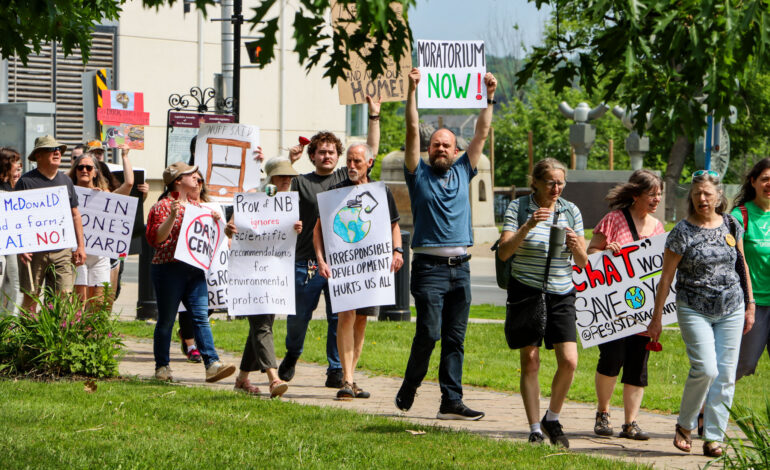
A moratorium for a temporary ban on AI data centres brought forth by the New Brunswick Green Party was voted down by the government.
Tantramar MLA Megan Mitton’s motion was due to a proposed hyperscale data centre in Spruce Lake Industrial Park, just outside Lorneville near Saint John.
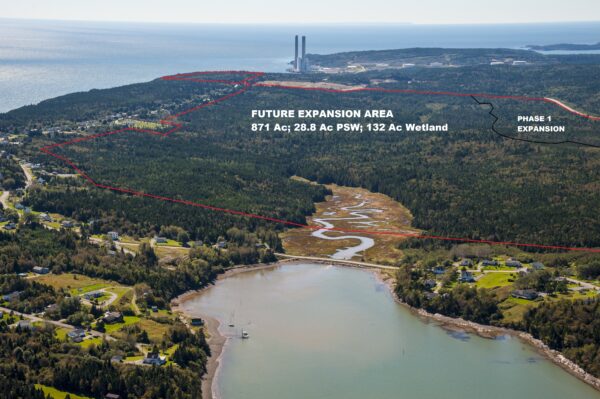
The data centre is proposed by Beacon Data Centres, a company based in Alberta, and VoltaGrid, a company based in Texas.
Both companies say construction is planned to begin this year, and operation is planned for 2028.
The Courier requested an interview with VoltaGrid, but one was not provided.
Beacon, the owner of the data centre, said in an emailed statement to The Courier, the data centre represents a long-term investment in the community.
“Beacon is excited about the opportunity to advance the Spruce Lake Campus and help position Saint John and New Brunswick as leaders in the next generation of digital infrastructure,” the company said in the statement.
What is an AI data centre?
An AI data centre is a facility specialized for the processing of artificial intelligence data.
Processing means training AI on specific tasks and running high-workload activities such as image generation or facial recognition.
AI data centres are different from our traditional data centres.
“Our other concern is that it’s going to be… the third largest carbon emitter in New Brunswick,” Nelson said. “It’s going to have a huge carbon footprint that is not being talked about enough.”
Data centres have been in our communities for years, including in some of New Brunswick’s major cities. The centres we already have are facilities that house servers, storage systems, and networking equipment used to run websites, email systems, and other digital services.
Traditional data centres require much less computing power than their AI counterparts.
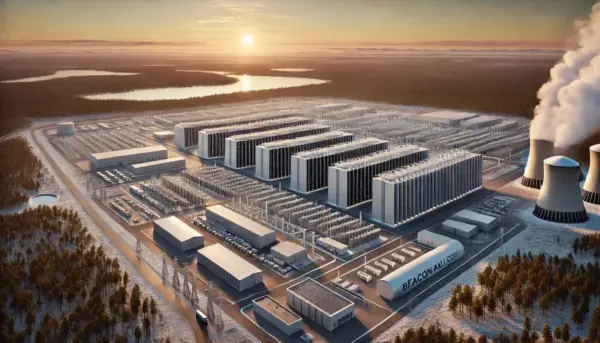
Companies have invested billions of dollars in creating centres in order to process the significant amount of computing power necessary for the usage of AI.
AI data centres are much larger than traditional centres, and come at an even larger cost in space, cooling systems, and electricity. There are six within about 80 kilometres of the proposed project in Lorneville.
The traditional Equinix data centre on McIntosh Street in Saint John is 3,320 square feet, equal to 0.002 per cent of the total area consumed by the proposed hyperscale centre.
The proposed moratorium
More than 100 individuals could be heard outside the legislature during a protest of the centre in early June — marching and chanting in opposition to the project and the uncertainty it poses to the province’s future.
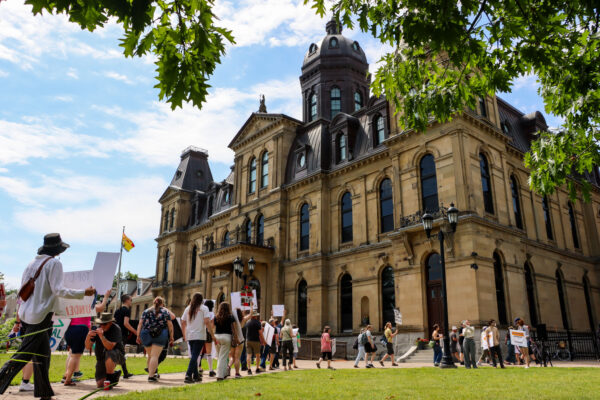
The march took place during the legislature’s second-last sitting of the season, which held the vote against Mitton’s moratorium. She spoke to protesters following the sitting.
“We need to be burning less gas, and less diesel, adding less to air pollution, not more,” Mitton said during her speech.
Co-organizer Sarah Nelson said she wants to hold people accountable.
“I feel it was a really personal issue for me and a lot of Lorneville people who feel they haven’t had a voice for a very long time,” Nelson said. “We have concerns over the pollution and the disruption it’s going to cause to the community.”

She said the New Brunswick electrical grid is already strained.
The proposed data centre will draw from NB Power and an on-site natural gas plant.
It will consume around 390 megawatts (MW) of electricity when operating at full capacity. That includes 190 MW from the on-site natural gas plant and 200 from NB Power.
Year-round, it will consume 3.4 terawatt-hours (TWh) of electricity. This sum is equivalent to, if not more than, the total electrical consumption of Moncton, and is around double the sum used by Saint John.
Nelson said it is unclear how the power usage will affect NB Power’s ratepayers.
“Our other concern is that it’s going to be… the third largest carbon emitter in New Brunswick,” Nelson said. “It’s going to have a huge carbon footprint that is not being talked about enough.”
It falls behind the Irving Oil Refinery and the Belledune generating station. This information was gathered during the company-ordered environmental impact assessment (EIA), which was carried out by Stantec, a Canadian consulting company.
NB Power said in a emailed statement ensuring secure and reliable energy for New Brunswickers is its main priority.
“Any new high‑demand customer, including data centres, must be integrated in a way that aligns with our Integrated Resource Plan (IRP) and the province’s overall supply needs,” the statement said, “For large customers, such as data centres, we could establish a flexible contractual agreement that minimizes pressure on the electrical grid and rates.”
Stantec did not respond to The Courier’s request for comment by publication.

The centre has 50 available natural gas-fired engines for electricity production. The EIA studied the facility at maximum capacity, but reported it would only need 42 to operate at that level.
The EIA projects an approximate 755,187 tonnes of CO2 per year of direct greenhouse gas (GHG) emissions. This is roughly 6.6 per cent of the province’s total emissions in 2023.
“We’re supposed to be progressing forward in being more sustainable, more green, and we’re moving backwards again,” Nelson said.
Ron Tremblay (Spasaquit Possesom), the traditional Grand Chief of the Wolastoqey Grand Council, was attending the protest. He highlighted concerns surrounding water usage.
“I recall back when my grandfather, who lived to be 96, mentioned to me that a third world war will be over fresh water,” Tremblay said. “Here we are, trying to create these AI industries all around our homeland, which use multitudes of water and, after it’s used, it’ll be full of chemicals.”
VoltaGrid and Beacon have said that the data centre will use a closed-loop liquid cooling system and air-cooled radiators.
“I didn’t set out to criticize it,” Jamieson said. “I thought, ‘what’s the big deal? I’ve permitted lots of data centres.’ ”
The centre will require an initial liquid amount of 3,500 cubic metres, roughly equivalent to 1.4 Olympic swimming pools. This amount will be pulled from the City of Saint John’s industrial water supply.
The City of Saint John did not respond to a request for comment.
Concerns from the community
Both Ann Jamieson and Chris Watson have expressed concern about the hyperscale data centre.
Jamieson is a retired air quality consultant. She has approved centres like this one in the past, however she looked over the EIA and found several issues.
Watson is a resident of Lorneville, whose backyard would be in the shadow of the data centre.
“What they want to do is rezone 1500 acres of land for heavy industry next to our community,” Watson said. “150 metres [away] from basically everyone’s home in Lorneville.”
He is one of 10 organizers of Save Lorneville, a social media-based group that formed two years ago and is dedicated to the protection of their community.
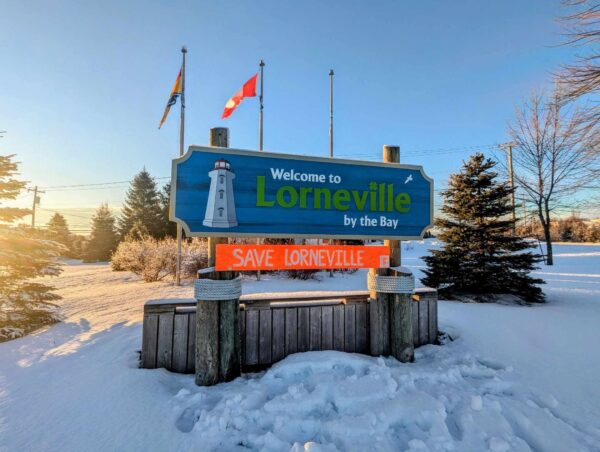
Watson said Lorneville is often lumped in with the Spruce Lake Industrial Park, but he explained the two are not the same.
“You pass through an industrial park, but then you drive into a community,” Watson said.
Watson said he isn’t entirely against the idea of a data centre, and he is more concerned with regulation and protecting the community.
Beacon said in its statement that the project “represents a significant long-term investment in the community, supporting construction activity, skilled permanent jobs, opportunities for local businesses, a new industry supporting substantial investment and new municipal and provincial revenues.”
“We’re going to lobby the city a bit with the new council to hopefully get some stronger by-laws in place,” said Watson.
He said the devil is in the details when speaking about the EIA, just like concerns highlighted by Jamieson.
“I didn’t set out to criticize it,” Jamieson said. “I thought, ‘What’s the big deal? I’ve permitted lots of data centres.’ ”
She said the air quality assessment caught her eye. She was concerned about the GHG emissions and the methods used to model the air quality dispersion.
She sent a letter to the New Brunswick Department of Environment and Local Government (ELG), following their response. She said that it left much to be desired.
“In my mind, the modelling was not done to current levels,” she said. “It was done in [sic] methodology that hasn’t been used for years in many parts of the country and certainly all over the world.”
She said when a model is done, it must take three things into account – what the area looks like currently, what it will look like and a model combining both conditions – she said the EIA did not do that.
She said it should have used emission data from the neighbouring fuel oil-fired power plant, Coleson Cove generating station, a large CO2 emitter in the area.
The government told her there is no viable emission data available for Coleson Cove. However, it is required to submit an annual report to the National Pollutant Release Inventory (NPRI) and the Greenhouse Gas Reporting Program (GHGRP).
The data is available online.
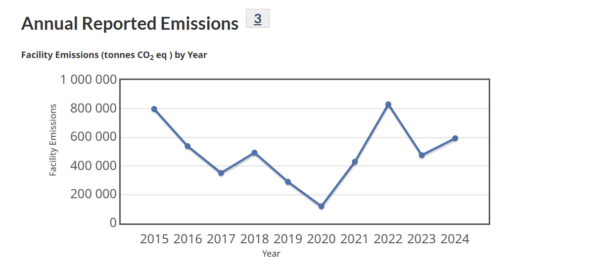
The Coleson Cove generating station emitted 579,966 tonnes of CO2 in 2024, according to the GHGRP. This sum is 77 per cent of the amount projected to be emitted by the proponent’s planned on-site gas plant. The total is also down from previous years.
“It is not okay to all of a sudden approve a big facility that’s going to pump out GHG when the rest of the world is trying to reduce GHG emissions,” she said.
The air quality monitoring system used by the proponent was not up to Jamieson’s standards. She said the proponent used air quality dispersion modelling (AERMOD), a system which, in her opinion, does not take effects of Coleson Cove into account.
She said the California Puff (CALPUFF) modelling system would have been a more accurate choice. CALPUFF uses a puff of air to simulate the movement and spread of pollutants.
“If they compare both [gas plants], I don’t know if it would comply with air quality standards,” she said.
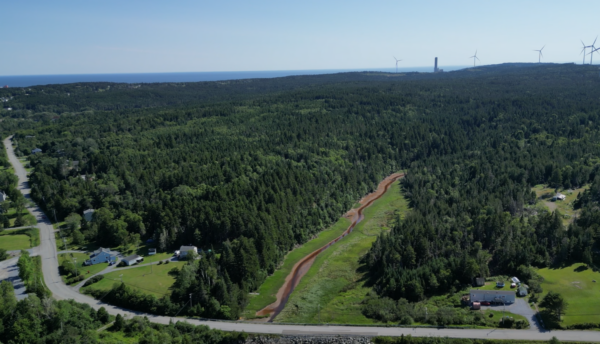
The EIA studied the area for the proposed project, including a 500 metre buffer past its boundary line, and is expected to take up 1782.7 hectares (ha). One hectare is roughly equal to the area of a soccer field.
Within 500 metres of the construction site is 182.2 ha of wetland and 1,103.6 ha of forested land. Concerns have also been raised about old-growth forest and trees that are estimated to be between 285 and 400 years old.
Jamieson said wetlands are important natural carbon sinks, which are areas that easily absorb carbon. She said she wasn’t sure if the proponent added the negative effects of wetland and forest destruction to the study when considering GHG emissions.
Jamieson also highlighted community concerns around water usage.
“Water isn’t an issue with this facility,” Jamieson said.
She reiterated that they are planning for a closed-loop water cooling system. It may have to be topped up every once in a while, but will not use much more than the initial amount.
The future of Lorneville
Residents are still concerned about the impact to local wildlife and the quality of life in Lorneville. Even after Save Lorneville met with the premier, Susan Holt, and Progressive Conservative MLA of Fundy-The Isles-Saint John Lorneville, Ian Lee.
Beacon said it is excited about the future of development in the area, adding the industrial park contains the industry and developmental capability necessary for this project.
“We look forward to continuing to work with residents, Indigenous communities, government, and local partners as the project moves forward,” Beacon said in its emailed statement.
Watson said the meeting did not provide the answers he was looking for.
He has sent a letter to the premier and minister, asking the province to: seriously consider a moratorium; treat the Lorneville proposal as one large project instead of breaking it into sections; require a comprehensive EIA; create rules for 24/7 low frequency hum emitted from the centre; require protection of wetlands; require an in person community consultation session for the EIA; and establish a task force on relations between the centre and the community.
The letter left them with one final request.
“We would appreciate a written response outlining which of these requests the province is prepared to act on, and what concrete steps will be taken to ensure the Lorneville community is meaningfully involved before further decisions are made.”